
Reviewed · OSLO TOURS
Free City Walking Tour in Oslo
Oslo’s best introduction may be a simple walk from the Tiger sculpture to Parliament. In about 90 minutes, this tour links the Opera House, Akershus Fortress, Aker Brygge, City Hall, the Royal Palace, and other central sights with stories about Norwegian life. It gives you the city’s basic shape before you start exploring on your own.
I like the easy central route, which keeps nearly everything within reach of the main railway station. I also like the mix of grand landmarks and small details, from Alfred Nobel and the Peace Center to Edvard Munch and the Norwegian royal family. The main consideration is pace: one 3-star account found more walking than talking, so you should not expect a long lecture at every stop.
Key points at a glance
- A 90-minute route through central Oslo: Start at the Tiger sculpture and finish near the Norwegian Parliament.
- Major sights without admission fees: See the Opera House, fortress, City Hall, Royal Palace, and Nobel Peace Center from the outside.
- A strong first-day activity: The route helps you understand Oslo’s layout and choose where to return later.
- Guides bring different strengths: Zoe, Nicholas, Nikola, Yellena, and Mia have led tours, with praise for friendly delivery and clear local stories.
- The group can reach 30 people: That keeps the price low, though a larger group may feel less personal.
- Low upfront cost, customary tip: The listed price is $3.45, while one account suggests planning on about $10 per person for a tip.
Start beside Oslo’s Tiger sculpture
The meeting point is the famous Tiger sculpture at Jernbanetorget, outside Oslo’s main railway station. This is a practical place to begin, especially if you have just arrived by train or are staying near the city center.
The statue gives the group an easy landmark to spot. From here, the route heads toward Bjørvika, the waterfront district where modern Oslo makes its first strong impression.
Your guide may be Zoe, Nicholas, Nikola, Yellena, Mia, or another member of the local team. The supplied comments single out these guides for warmth, humor, clear explanations, and a relaxed manner. That matters on a city walk. A good guide keeps you moving without making the tour feel like a race.
The tour is offered as a free walking experience, but the booking page shows a small charge of $3.45. You should also consider the normal tip expectation attached to this style of tour. One participant advised allowing roughly $10 per person. The final cost can therefore be higher than the booking amount, depending on what you choose to give the guide.
More City Tours in Oslo
- Oslo: City Sightseeing Hop-On Hop-Off Bus Tour
★ 3.6 · 724 reviews - Oslo: Grand City Sightseeing Tour by Bus with Fjord Cruise
★ 4.6 · 647 reviews - Oslo Combo Tour: Grand City Tour and Oslo Fjord Cruise
★ 4.5 · 555 reviews
The Opera House and Oslo’s new waterfront
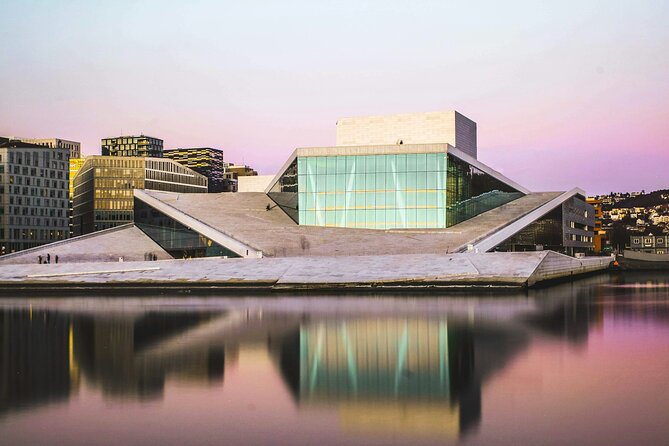
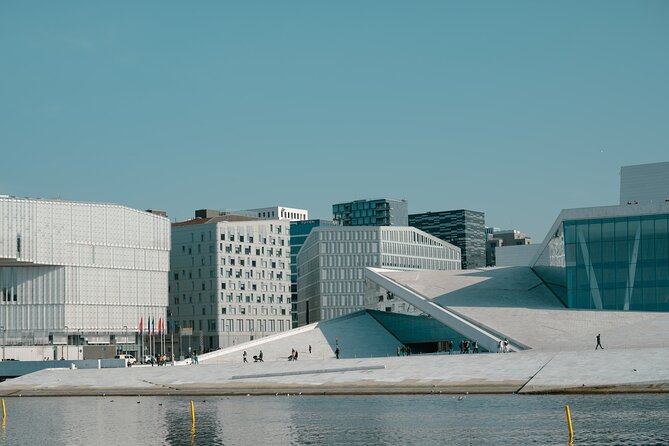
The Oslo Opera House is one of the tour’s most useful early stops. Its broad, sloping roof reaches down toward the water, and the route uses it as a doorway into several parts of modern Oslo.
You hear about the Public Library, the Munch Museum, Bjørvika, and Sørenga. These names help you place Oslo’s newer cultural and waterfront districts on the map. The tour does not include admission to the museums, but it gives you a reason to return if art, architecture, or urban redevelopment interests you.
The Opera House stop lasts about 10 minutes. That is enough time for an explanation and a look around, but not enough for a detailed architectural talk or an indoor visit. I see this as a strength if you want orientation, not a drawback. You keep moving and cover more ground.
The route also passes the world’s smallest stock exchange, according to the supplied description. It is a quick, unusual fact rather than a full stop with a long visit. Small details like this help break up the larger stories about palaces and national institutions.
Kvadraturen and Christiania Square
Next comes Kvadraturen, one of the central areas linked with Christiania Square. The name points to Oslo’s older street plan and the city’s earlier identity as Christiania.
This seven-minute stop adds historical texture after the modern waterfront. You move from glass, water, and new cultural buildings into a part of town associated with the older city center.
Do not expect a long, museum-style explanation here. The value is in seeing how Oslo’s past and present sit close together. The short stop also keeps the route manageable for people who want a broad introduction rather than a specialist history walk.
Akershus Fortress and Alfred Nobel
Akershus Castle and Fortress is one of the strongest parts of the route. The old defensive complex gives you a change of setting, along with views from higher ground and a story connected to Alfred Nobel.
The tour includes the fortress stop for about eight minutes. The information provided does not promise an interior visit, so you should treat this as an outdoor orientation stop rather than a castle tour. Admission is marked as included, but the experience itself remains a walking visit within the wider route.
The fortress helps explain Oslo’s strategic position and gives the guide a natural place to talk about Nobel and the city’s connection to the Nobel Peace Prize. You will later pass the Nobel Peace Center, so the story gains a second reference point.
This is also one of the places where the walking matters. One response from the operator specifically describes views from the top of the fortress, and the route gives you a chance to see the city from a different angle. If your main reason for booking is a series of postcard views, this section should be one of the more satisfying moments.
More Walking Tours in Oslo
- Oslo: Best of Oslo Walking Tour
★ 4.5 · 458 reviews - Oslo: Guided Walking Tour of Central Oslo
★ 4.7 · 438 reviews - Oslo: Historic Myths & Legends Evening Walking Tour
★ 4.8 · 408 reviews - Taste of Oslo Walking Tour
★ 4.5 · 282 reviews
Aker Brygge, the National Museum, and the Peace Center
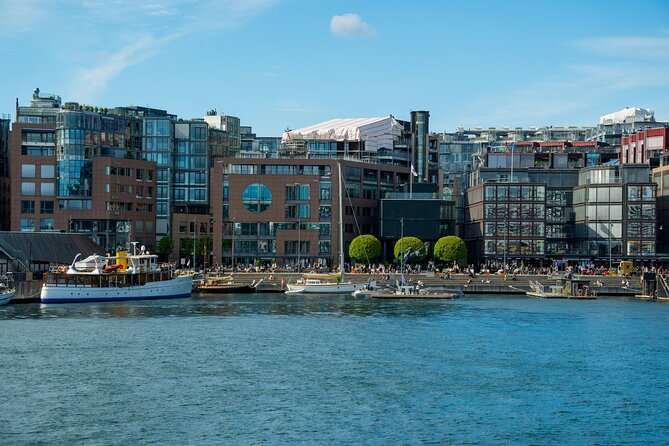
From the fortress, the walk continues toward Aker Brygge. This waterfront district brings together restaurants, public spaces, museums, and views across the harbor.
The stop covers Aker Brygge, the National Museum, and the Nobel Peace Center in about seven minutes. Again, you are seeing the outside and hearing context rather than entering the museums. That distinction is important. Anyone hoping to visit the Munch Museum, National Museum, or Peace Center should set aside separate time and admission money.
Still, the route gives you a useful first look at Oslo’s cultural center. You can decide which building deserves a return visit, instead of trying to fit every museum into a crowded first day.
I like this part because it connects culture with ordinary city life. Aker Brygge is not only a landmark zone. It is also part of the city’s everyday waterfront, and the walk lets you see how Oslo uses its harbor for public space.
City Hall and the Nobel Peace Center
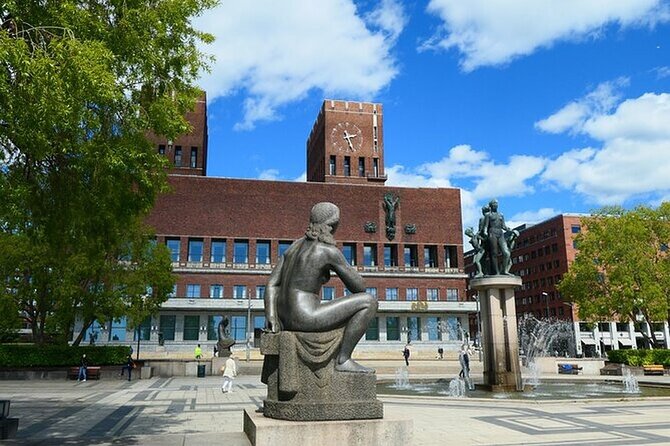
Oslo City Hall, or Rådhuset, receives about 10 minutes, one of the longer stops. This makes sense. The building is a major civic symbol, and the guide can connect it with city government, public life, and the Nobel Peace Prize ceremony held in Oslo.
The nearby Nobel Peace Center gives the route another clear link to Alfred Nobel. If you are unfamiliar with the division between the Nobel awards in Stockholm and the Peace Prize in Oslo, this section can help you understand why the city has such a strong Nobel identity.
The tour does not promise an indoor look at City Hall or the Peace Center. You should plan around an exterior visit. That keeps the walk free and within its 90-minute limit, but it also means the stop will feel brief if you want detailed art, architecture, or political history.
National Theatre and Henrik Ibsen
Nationaltheatret is a shorter stop, lasting about six minutes. The guide uses it to introduce Henrik Ibsen, one of Norway’s best-known writers.
This is a good example of the tour’s broad range. In a single walk, you get royal stories, national politics, modern museums, Nobel history, civic buildings, and Norwegian literature. You will not become an Ibsen expert here, but you will understand why the theater belongs on a central Oslo route.
The shorter timing may suit you if you prefer variety. If you want a literary tour focused on Ibsen, this will feel too quick. Think of it as a signpost toward a subject you can explore later.
The University Aula and Edvard Munch
The University Aula is one of the more distinctive stops. The guide explains its connection with Edvard Munch, who painted there.
The stop lasts roughly four minutes, so the story is likely to be brief. Even so, it adds an artistic layer to the route that is easy to miss when you are simply walking along Karl Johans gate.
For art lovers, this can be a useful prompt to visit the Munch Museum later. For everyone else, it is a compact story that shows how Oslo’s university, public buildings, and artists overlap.
The walk does not include a museum ticket or a dedicated gallery visit. You get context, not a full art lesson. That is fair for a low-cost orientation tour, but keep your expectations in the right place.
The Royal Palace and the Norwegian royal family
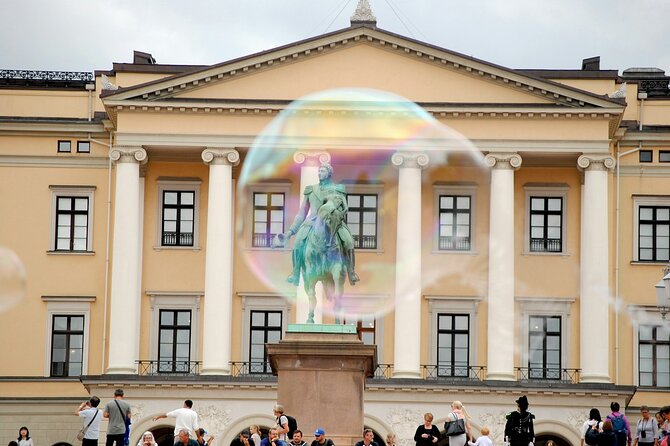
The Royal Palace is one of the tour’s signature sights. Here the guide shares stories about the Norwegian royal family and gives you a look at the palace grounds from the public route.
The palace stop lasts about eight minutes. This is enough for an introduction to the monarchy and its place in Norwegian society, but not enough for an extended tour of royal rooms or ceremonies.
I find the royal section useful because it brings national identity down to a human scale. Instead of only seeing a grand building, you hear how the royal family fits into modern Norwegian life. The guide’s local perspective matters here, especially when explaining customs that may not be obvious to someone visiting from abroad.
The route is also practical. The palace sits along one of Oslo’s most important central streets, so you can easily return later for a slower look at the grounds and nearby attractions.
Parliament and the final walk back
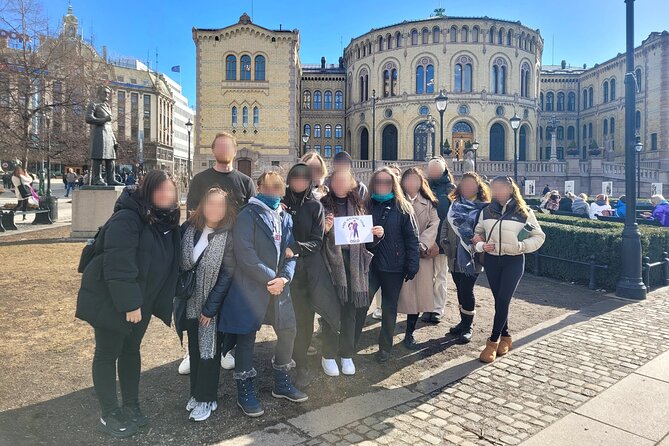
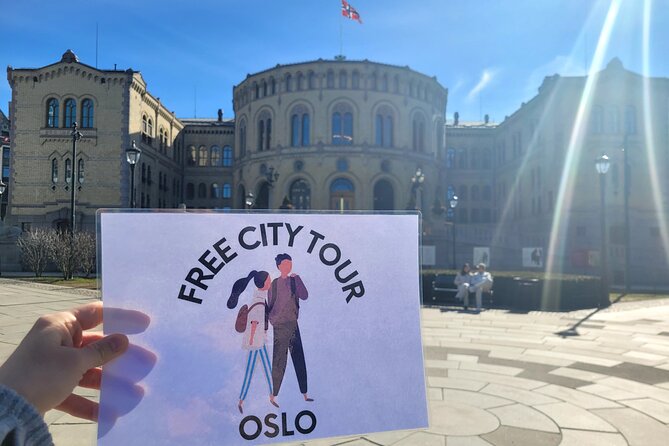
The tour finishes at the Norwegian Parliament on Karl Johans gate. The final stop lasts about eight minutes, and the end point is about a 10-minute walk from the Tiger sculpture.
That return distance is worth noting. You do not finish beside the railway station, but you remain in the heart of central Oslo, close to shops, restaurants, public transport, and other sights.
Parliament makes a sensible final stop. After hearing about royal life, civic buildings, Nobel work, literature, and the city’s development, you end with Norway’s elected national institution. It gives the route a clear structure rather than simply stopping at a random corner.
You may want to remain in this area after the tour. The end point is convenient for continuing along Karl Johans gate or returning toward the station.
What the pace and group size mean
The advertised duration is about one hour and 30 minutes. Several strong comments describe that length as ideal for seeing central Oslo without tiring yourself out. The route has around 10 stops, so the guide must keep explanations focused.
The maximum group size is 30 people. That is not a tiny private walk, but it is still workable for a central city tour. A group of that size can make street crossings and gathering around landmarks slower, and it may be harder to ask a long string of questions.
Most people can take part, and service animals are allowed. The tour meets near public transportation, which makes it easy to reach. You should still wear comfortable shoes and prepare for outdoor conditions. One account specifically mentions chilly wind, and Oslo weather can make a stationary explanation feel colder than the walking itself.
The feedback is not entirely uniform. The strongest comments praise the guides for being fun, friendly, professional, and well informed. One person felt there was too much walking and not enough explanation, while another account described a guide speaking too quickly and finishing early. The operator disputed some of these comments as belonging to a different business, so I would not treat them as a clear pattern. Still, they point to a sensible tip: if you need slow, detailed explanations, tell the guide early.
Who should book this Oslo walk?
I would choose this tour for a first morning or afternoon in Oslo. It gives you a working map of the center, shows you the major public sights, and helps you choose where to spend more time later.
It suits you especially well if you want:
- A short introduction before visiting museums
- Stories about Norwegian culture and daily life
- A mix of modern waterfront sights and older civic buildings
- A central route that ends near Parliament
- A low-cost activity for a first day in the city
You may prefer another experience if you want interiors, long historical lectures, detailed art commentary, or a slower photographic walk. This is a broad city sampler. Its value comes from the range of places covered in 90 minutes, not from extended time at any single sight.
The guides named in the supplied material include Zoe, Nicholas, Nikola, Yellena, and Mia. Guide quality can vary from one departure to another, but the repeated praise centers on humor, friendliness, clear local insight, and the ability to answer questions.
Price, tips, and cancellation
At $3.45 per person, the listed price is unusually low for a guided city walk. The word free reflects the tour model, not necessarily the full amount you may choose to spend. Plan for a tip, with about $10 per person suggested in one account, and judge the amount by the quality and length of your guide’s work.
You receive a mobile ticket, and confirmation comes at booking. The tour requires a minimum number of participants. If that minimum is not met and the experience is canceled, you are offered another date or experience, or a full refund.
You can cancel for a full refund up to 24 hours before the start time. Cancellations or changes made within 24 hours are not refunded or accepted. The cut-off uses Oslo local time, so check the time carefully if you are booking from another country.
Should you book the Free City Walking Tour in Oslo?
Book it if you want a fast, low-cost grounding in central Oslo. The route covers more than a dozen useful reference points, from the Opera House and Bjørvika to Akershus Fortress, City Hall, the palace, and Parliament.
I would book it early in your stay, then use the guide’s suggestions to plan museum visits and return walks. Just remember that you are getting outside commentary, not admission to Oslo’s major cultural sites, and that a tip is part of the normal arrangement.
If you prefer a quiet, highly detailed tour with plenty of time at each sight, this may feel brisk. For most first-time visitors who want a friendly overview, a little local humor, and a clear sense of how central Oslo fits together, it is a sound choice.
FAQ
How long does the Free City Walking Tour in Oslo last?
The tour lasts approximately one hour and 30 minutes.
Where does the tour start?
It starts at the Tiger sculpture at Jernbanetorget, 0154 Oslo, Norway.
Where does the tour finish?
It finishes near the Norwegian Parliament at Karl Johans gate 22, 0026 Oslo. The end point is about a 10-minute walk from the Tiger sculpture.
What sights are included?
The route includes the Opera House, Kvadraturen and Christiania Square, Akershus Castle and Fortress, Aker Brygge, City Hall, Nationaltheatret, the University Aula, the Royal Palace, and the Norwegian Parliament.
Does the tour enter the museums?
The tour description names the Public Library, Munch Museum, National Museum, and Nobel Peace Center, but it does not state that museum admission or indoor visits are included.
Is the tour really free?
The experience is presented as a free walking tour, but the listed booking price is $3.45 per person. A tip is expected in this style of tour, and one account suggests about $10 per person.
How many people can join?
The tour has a maximum group size of 30 participants.
Is the tour accessible by public transportation?
Yes. The meeting point is near public transportation.
Are service animals allowed?
Yes, service animals are allowed.
Can most people participate?
The provided information says most participants can take part.
What is the cancellation policy?
You can cancel at least 24 hours before the start time for a full refund. Cancellations or changes made less than 24 hours before the start time are not refunded or accepted.
Recently added around Oslo
- The Vigeland Park in Oslo: Insta-Perfect Walk with a Local★ 5.0 · 3 reviews
- Oslo: Best of Oslo Walking Tour and Hop-on Hop-off Bus Tour★ 3.7 · 3 reviews
- Best of Oslo: Walking Tour with a local guide★ 4.6 · 3 reviews
- Afternoon Tea and Classic Concert on the Fjord★ 4.5 · 3 reviews
- Lake walk and campfire★ 4.7 · 3 reviews
- Maral Kunst : Jewelry Bar Experience (Jewelry Making)★ 5.0 · 3 reviews
- Oslo: Yoga & Hiking with a dog★ 5.0 · 3 reviews
- Oslo: Skjennungstoppen Wildlife Forest Hiking Tour★ 5.0 · 3 reviews
Oslo Tours, compared.

Scenic Fjord Cruise with Audio Guide Commentary
Read our review →


Guided Sightseeing Fjord Cruise on Premium Silent Boat
Read our review →
Browse the lists this tour appears in