
Reviewed · OSLO TOURS
Oslo City Walks – The City of Contrasts
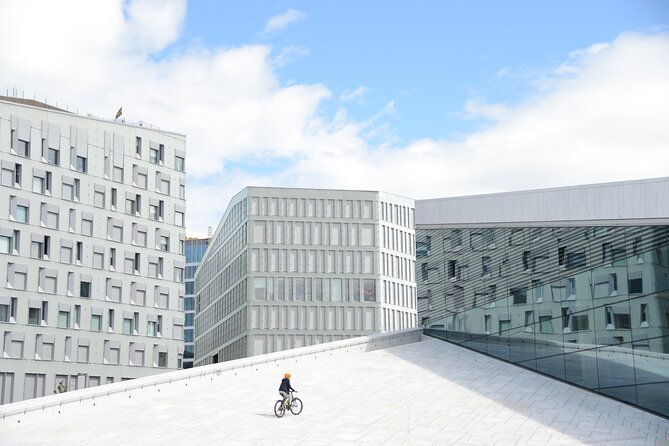
Oslo’s story is easiest to grasp on foot, where a striking white marble Opera House gives way to new museums, a clever pedestrian bridge, and older streets in Kvadraturen. I like that this two-hour walk shows Oslo as a city still changing, not a place frozen in its past. I also like the compact route and small maximum group of 20, which should make it easier to hear the local guide.
The main thing to weigh is the pace. You cover several areas in about two hours, and the walk operates in all weather. The Opera House roof visit depends on time, while entry to Munch is not included, so this works best as an introduction rather than a full museum tour.
Key points to know before you book
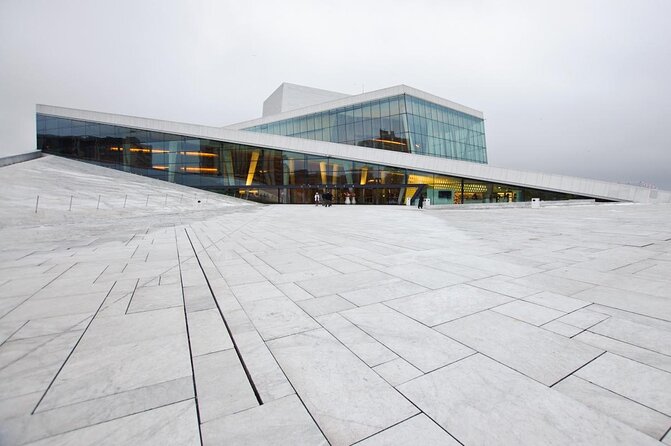
- The Opera House roof may be part of the walk: If time allows, you can stroll on the building’s sloping roof at no extra admission cost.
- Bjørvika is the main story: The route shows how a former container port area is becoming a cultural district.
- Munch is a scheduled highlight: You spend about 20 minutes at the museum area, but museum admission is not included.
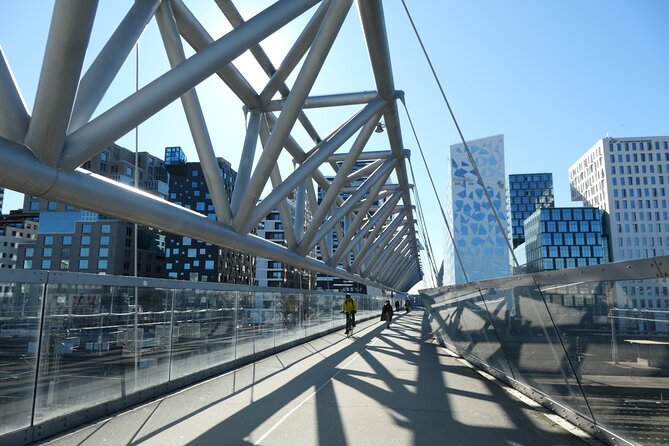
- Akrobaten Bridge links two parts of Oslo: The 10-minute stop gives you a different view of Bjørvika and Grønland.
- The walk ends at Deichman Bjørvika: You finish near the modern public library, not back at the starting point.
- The group is capped at 20 people: That is a useful middle ground between a private walk and a large coach tour.
Oslo in two hours: a city changing under your feet
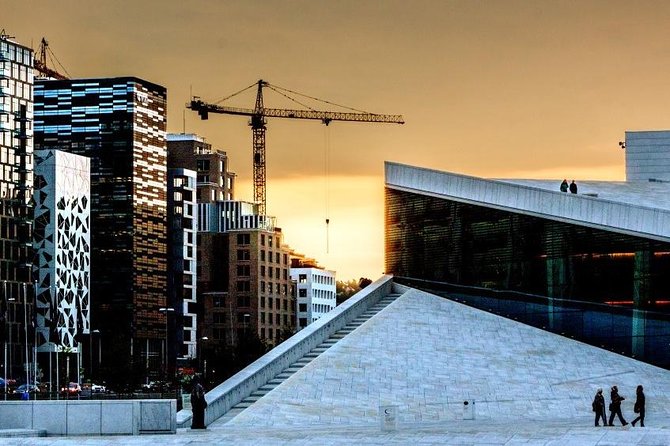
This walk gives you a clear theme from the start: Oslo is a city of contrasts. Old central streets sit close to bold new buildings, and former working areas are being reshaped into places for art, books, music, and public life.
That theme matters because Oslo can seem polished and modern at first glance. A guided walk helps connect the pieces. You are not simply ticking off buildings. You are seeing how the city’s older center relates to Bjørvika, one of its fastest-changing areas.
The timing is useful for a first afternoon or evening in Oslo. The tour begins at 5:00 pm, lasts about two hours, and ends at Deichman Bjørvika. You can use it to get your bearings early in a visit, or choose it after spending the day elsewhere in the city.
The route is not designed as an all-day historical survey. It gives you a focused look at central Oslo’s architecture and redevelopment. If you want every major museum, palace, and neighborhood covered, you will need more time on your own.
More City Tours in Oslo
- Oslo: City Sightseeing Hop-On Hop-Off Bus Tour
★ 3.6 · 724 reviews - Oslo: Grand City Sightseeing Tour by Bus with Fjord Cruise
★ 4.6 · 647 reviews - Oslo Combo Tour: Grand City Tour and Oslo Fjord Cruise
★ 4.5 · 555 reviews
Starting at Oslo Visitor Center
You meet at Oslo Visitor Center at Jernbanetorget 1, a practical central location near public transportation. This makes the meeting point fairly easy to reach if you are already in central Oslo.
The walk is offered in English, and a local guide leads the group. No guide name is provided, so you cannot request a particular person in advance. Still, the strongest praise attached to the experience focuses on the guide’s enthusiasm and ability to explain the city clearly. That is important on a city walk built around urban change, since the buildings alone do not tell the whole story.
The maximum group size is 20. I consider that a sensible limit. It is small enough for a guide to manage without the walk feeling like a private tour, though it is not intimate in the way a tour for six or eight people would be.
Wear shoes you can walk in and bring clothing suited to the forecast. The tour runs in all weather, so rain, wind, or cool evening temperatures can affect how much you enjoy the route. Oslo weather can change quickly, and the walk includes outdoor stops rather than a long stretch inside.
The Opera House roof and Oslo’s modern face
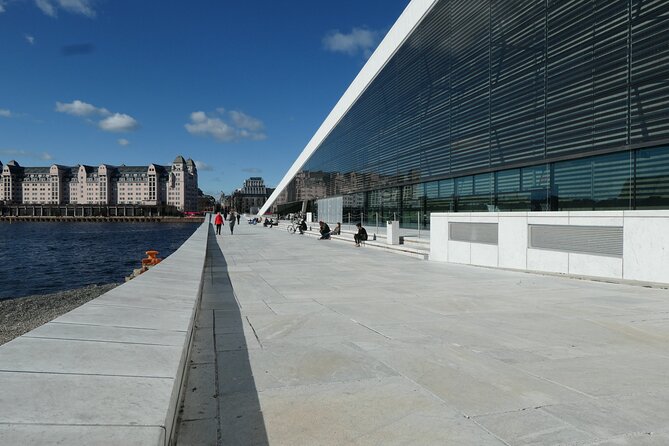
The Norwegian National Opera & Ballet is the natural opening attraction. Its pale, sloping form reaches toward the water, creating a public surface that people can walk across. If time allows, the guide takes you onto the roof.
That roof walk is one of the tour’s best details. It turns a famous building from something you photograph into a place you physically explore. You can look at the structure from different angles, and the open setting helps you understand why the Opera House became such an important part of Oslo’s modern identity.
Admission to the Opera House stop is free. The catch is in the phrase if time allows. Since the walk has several scheduled points and lasts only about two hours, the roof visit is not guaranteed. If this is your main reason for booking, keep your expectations flexible.
The Opera House also sets up the tour’s central contrast. It is bold, new, and open to public use, yet it sits within a city with older streets and long-established buildings. The guide can help you see this not as a clash between old and new, but as two parts of Oslo operating side by side.
Munch and the changing Bjørvika district
The next major stop is Munch, the museum that opened in October 2021. Its location in Bjørvika places it at the center of one of Oslo’s most visible changes.
You spend about 20 minutes at this stop. Museum admission is not included, so this part of the tour should be understood as an outside visit or an introduction rather than a full museum session. If you want to see Edvard Munch’s works inside, you will need to arrange a separate museum visit and pay the entry cost yourself.
That limitation is also useful. You can learn how the museum fits into the new cultural district without spending the whole afternoon indoors. The guide’s job here is to connect the building and its setting to Bjørvika’s wider redevelopment.
Bjørvika was once associated with port activity and container storage. The area is now being shaped as a cultural hub, with major public buildings and new pedestrian connections. The value of this stop is seeing the change in place rather than hearing about it as an abstract city-planning idea.
If you are interested in architecture, public space, or how cities reuse waterfront areas, this part of the walk will likely be especially useful. If your priority is viewing Munch’s art, budget extra time before or after the tour.
A few more Oslo half-days to weigh up
- Oslo: Scenic Fjord Cruise with Audio Guide Commentary
★ 4.5 · 5,375 reviews - Oslo Nature Walks: Island Hopping Tour
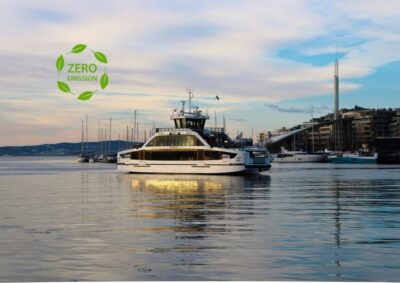
★ 4.8 · 2,713 reviews - Oslo: 100% Electric Oslofjord Sightseeing Cruise
★ 4.4 · 2,041 reviews - Oslo: Fjord Evening Cruise with Shrimp Buffet
★ 4.5 · 1,956 reviews
Crossing Akrobaten Bridge between Grønland and Bjørvika
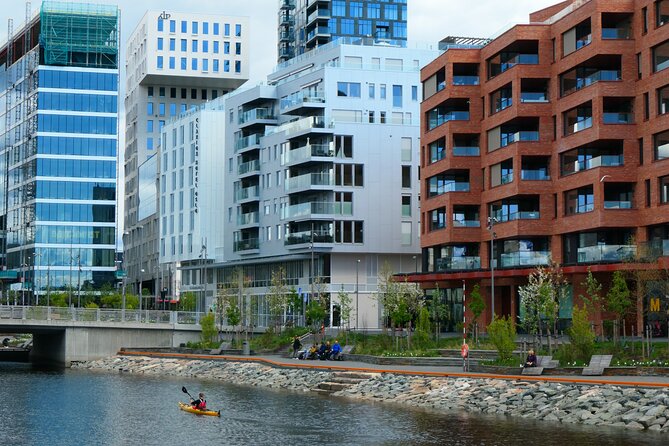
The Akrobaten Pedestrian Bridge provides a different kind of stop. The bridge links Grønland and Bjørvika, and the tour spends about 10 minutes here.
A bridge may sound less important than a museum or opera house, but it shows how daily movement shapes a city. This crossing is a practical connection as well as a recognizable piece of modern design. From here, you get a sense of how the newer Bjørvika area relates to Grønland.
The stop is brief, so do not expect a long architectural lecture or a leisurely photography session. Instead, think of it as a visual pause in the route. The bridge helps you see the areas as connected parts of Oslo rather than separate attractions.
I like this inclusion because it keeps the walk grounded. The tour is not only about headline buildings. It also shows the links that make a redeveloped district usable.
Kvadraturen and Oslo’s older center
The tour also brings you through Kvadraturen, an older central area with strong ties to Oslo’s early civic and dining life. It is home to Oslo’s oldest restaurant and what was once the city’s original town hall.
These details give the walk a needed historical counterweight. After the sleek lines of Bjørvika, Kvadraturen brings you back to older streets and the city’s earlier public life. The contrast is the point. Oslo’s modernization makes more sense when you can place it beside the structures and institutions that came before.
The supplied schedule gives specific timing for the Opera House, Munch, and Akrobaten Bridge, but it does not assign a separate duration to Kvadraturen. The exact amount of time there may depend on the guide and the walking pace. If you want a long, detailed study of the old center, this tour may feel too short. If you want a quick connection between old Oslo and new Oslo, it should fit well.
What $53.31 means in practical value
At $53.31 per person, this is not a free orientation walk, but it can be good value if you want a guide to explain the city’s redevelopment in a short period. You are paying for a local guide, a planned route, and context that is easy to miss when you explore the buildings alone.
The value is strongest for first-time visitors with limited time. In two hours, you see several important parts of central Oslo and finish near one of the city’s major public cultural buildings. You also avoid spending the whole evening on a single museum or attraction.
The value is weaker if you mainly want indoor admission. Munch is not included, and the Opera House roof depends on available time. You should compare this tour with your own interests before booking. It suits someone who wants interpretation and orientation, not someone looking for a ticket bundle.
The free cancellation policy also reduces the risk of booking early. You can cancel for a full refund up to 24 hours before the start time. Changes or cancellations made inside that 24-hour window are not accepted for a refund, so watch the local Oslo time.
Who will get the most from this walk?
I would choose this tour for a first visit to Oslo, especially if you want to understand the city before exploring it independently. The route introduces major modern landmarks while still making room for Kvadraturen’s older identity.
It also suits architecture fans and anyone interested in urban renewal. The Opera House, Munch museum, Akrobaten Bridge, and Bjørvika redevelopment all show different ways a city can reshape its waterfront and public spaces.
The tour can work for families and older visitors who are comfortable walking for about two hours, but the physical fitness requirement should be taken seriously. There is no indication of hotel pickup or drop-off, and the walk takes place outdoors in all weather.
You may want something else if you need a fully accessible, weather-protected activity, a private guide, or a long visit inside Munch. You may also prefer a longer historical tour if Kvadraturen is your main interest.
Service animals are allowed, and the route is near public transportation. Those points make the walk easier to fit into a wider Oslo schedule, but you still need to arrange your own way to the meeting point and from the final stop.
Planning the rest of your evening
Because the tour ends at Deichman Bjørvika, plan around the finish rather than assuming you will return to Jernbanetorget. The end point is Anne-Cath, Vestlys plass 1, 0150 Oslo.
That finish is useful if you want to continue exploring Bjørvika on your own. It also gives you a clear place to stop after the guide’s route. The tour does not include hotel transportation, so check your onward plans before setting out.
The 5:00 pm start gives the walk an evening feel, but daylight and weather will vary by season. The tour still operates in poor weather, so pack a waterproof layer and wear shoes suited to city streets. You will enjoy the outdoor stops more if you are prepared.
Should you book Oslo City Walks?
Book it if you want a short, guide-led introduction to Oslo’s contrasts, with a strong focus on Bjørvika, architecture, and the relationship between old and new parts of the capital. The small group cap, English-language format, and free cancellation add practical value.
Skip it if you want extensive museum time, guaranteed access to the Opera House roof, or a tour devoted mainly to historic Oslo. At about two hours, this is a focused orientation walk, not a complete city tour.
For many first-time visitors, that focus is its strength. You leave with a clearer sense of how Oslo is changing and a useful starting point for exploring the city on your own.
FAQ
Where does the Oslo City Walks tour start?
The tour starts at Oslo Visitor Center, Jernbanetorget 1, 0154 Oslo, Norway.
What time does the tour begin?
The tour begins at 5:00 pm.
How long does the walking tour last?
The tour lasts approximately two hours.
Where does the tour end?
The tour ends at Deichman Bjørvika, Anne-Cath, Vestlys plass 1, 0150 Oslo, Norway.
Is the tour offered in English?
Yes. The tour is offered in English.
Is admission to the Opera House included?
The Opera House stop has no admission charge. If time allows, the guide may take you for a walk on the roof.
Is admission to Munch included?
No. Admission to Munch is not included.
What happens if the weather is poor?
The tour operates in all weather conditions, so you should dress appropriately.
How large is the tour group?
The tour has a maximum of 20 travelers.
Recently added around Oslo
- The Vigeland Park in Oslo: Insta-Perfect Walk with a Local★ 5.0 · 3 reviews
- Oslo: Best of Oslo Walking Tour and Hop-on Hop-off Bus Tour★ 3.7 · 3 reviews
- Best of Oslo: Walking Tour with a local guide★ 4.6 · 3 reviews
- Afternoon Tea and Classic Concert on the Fjord★ 4.5 · 3 reviews
- Maral Kunst : Jewelry Bar Experience (Jewelry Making)★ 5.0 · 3 reviews
- Lake walk and campfire★ 4.7 · 3 reviews
- Oslo: Yoga & Hiking with a dog★ 5.0 · 3 reviews
- Oslo: Skjennungstoppen Wildlife Forest Hiking Tour★ 5.0 · 3 reviews
Oslo Tours, compared.
Scenic Fjord Cruise with Audio Guide Commentary
Read our review →

Guided Sightseeing Fjord Cruise on Premium Silent Boat
Read our review →
Browse the lists this tour appears in