
Reviewed · OSLO TOURS
Central Oslo Guided Walking Tour with Local Guide
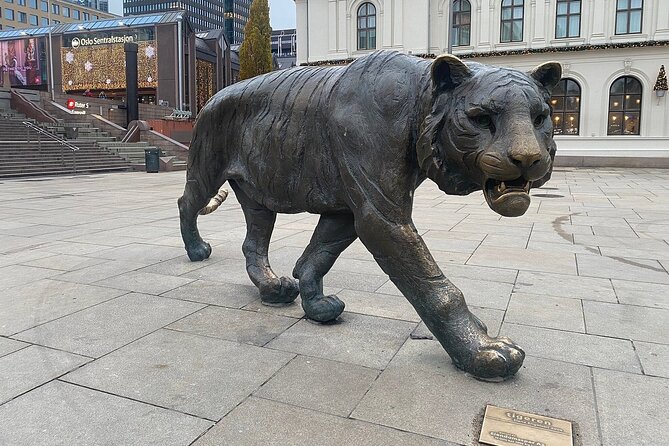
Oslo’s story unfolds nicely on foot, from the Tiger sculpture at Central Station to the Royal Palace. In about two hours, you move through the city’s medieval roots, waterfront redevelopment, royal avenues, and modern public buildings without spending much money.
I like the route’s range: Akershus Fortress gives you a sense of medieval Oslo, while the Opera House and Aker Brygge show the city’s newer face. I also like the guides’ conversational style. Suzanne, Alexia, Marta, Daniel, Kamil, and others have been praised for mixing history, Norwegian culture, useful tips, and humor instead of delivering a dry lecture.
The main drawback is simple: this is a walking overview, not a series of museum visits. Although Akershus Fortress is described as a castle and museum, the tour does not include entry inside buildings. The group can reach 27 people, and a few people have found the guide hard to hear or the pace too quick.
Key points to know before booking
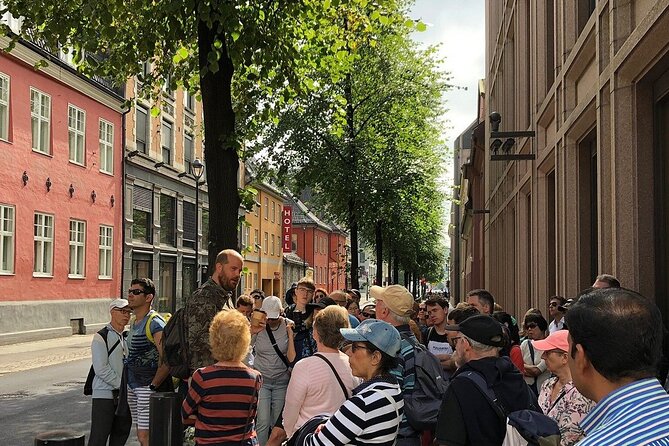
- The route connects Oslo’s major central sights: You see the Tiger, Opera House, City Hall, cathedral, Parliament, Aker Brygge, Akershus Fortress, Karl Johans gate, and the Royal Palace.
- The tour begins at Jernbanetorget: This is a handy meeting point near Oslo Central Station and public transport.
- The walk takes about two hours: The pace is generally gentle, though you cover several city blocks and should be ready to walk continuously.
- History comes with humor: Strong guides explain Oslo’s links with Denmark and Sweden, Norwegian culture, and the stories behind the buildings.
- The price is unusually low: At $16.94 per person, it is a good-value orientation walk if you want a broad introduction rather than deep access to one attraction.
- The tour ends at the Royal Palace: You finish at Slottsplassen, a useful place to continue exploring central Oslo on your own.
Why this walk works well on your first day
I often find a city walk most useful at the beginning of a stay, before you have formed a clear map in your head. This route does that job well. It links the station, harbor, historic center, main shopping street, parliament, and palace, so you can return later to the places that catch your interest.
The route also gives you several versions of Oslo in quick succession. At Jernbanetorget, the Tiger is a modern city symbol. At Akershus, you get medieval defenses and centuries of military use. Along Karl Johans gate, the focus shifts to national institutions, shops, restaurants, and daily city life.
The strongest guides make the walk feel like a conversation. Daniel has been praised for combining Norwegian history with fun facts and humor, while Alexia has been noted for explaining Norwegian culture along with the landmarks. Suzanne and Marta have also received praise for answering questions and offering ideas for the rest of an Oslo visit.
That quality can vary by guide. One poor experience described a surface-level tour, even though the guide was easy to hear. So I would book this for orientation, context, and a pleasant walk, not because every guide will provide a specialist-level history lesson.
More Walking Tours in Oslo
- Oslo: Best of Oslo Walking Tour
★ 4.5 · 458 reviews - Oslo: Guided Walking Tour of Central Oslo
★ 4.7 · 438 reviews - Oslo: Historic Myths & Legends Evening Walking Tour
★ 4.8 · 408 reviews
Starting with Oslo’s Tiger at Jernbanetorget
The meeting point is the Tiger sculpture at Jernbanetorget, postal code 0154, near Oslo Central Station. This is a practical start if you are arriving by train or using public transportation.
The Tiger was installed in 2000 to mark Oslo’s millennium. It reflects the city’s nickname, the Tiger City, and has become one of Oslo’s most recognizable meeting points. Your guide uses it as an opening to explain how a city can turn a nickname into a public symbol.
You spend about 10 minutes here, with no admission fee. It is a short stop, but it gets the group together and gives you an easy landmark for finding the meeting place.
From here, the route moves toward the waterfront and the Oslo Opera House. The exact order can vary slightly, but the experience is built around walking between the city’s main sights rather than stopping for long periods at one attraction.
The Opera House and Oslo’s modern waterfront
The Oslo Opera House is one of the most memorable buildings on the route. Completed in 2008, it is home to the Norwegian National Opera and Ballet and is known for its modern design and waterfront location.
You should think of this stop as an architectural and urban-planning lesson rather than a performance visit. The building represents the newer Oslo, where public space and the harbor are closely connected. Its location also helps explain why the waterfront is such an important part of the city’s identity.
The tour does not include admission to the Opera House or any other building. You see the exterior and hear the guide’s explanation, then continue on foot. That is enough for a first look, but you will need a separate visit if you want to attend a performance or spend more time inside.
Rådhusgata and the older city center
Rådhusgata gives the walk a historical change of pace. The street dates from the 1620s and leads toward Oslo City Hall. It helps you picture the older central city and the way Oslo developed around its civic and waterfront areas.
This kind of street-level stop is one reason a guided walk can be more useful than simply ticking off famous buildings. You are not only looking at a facade. You are connecting streets, institutions, and the city’s growth over time.
The stop is listed at about 10 minutes and has no admission fee. Do not expect a long pause here. The value comes from the explanation and the connection to the next major sight.
A different way to spend a day from here:
- Oslo: Scenic Fjord Cruise with Audio Guide Commentary
★ 4.5 · 5,375 reviews - Oslo Nature Walks: Island Hopping Tour
★ 4.8 · 2,713 reviews - Oslo: 100% Electric Oslofjord Sightseeing Cruise
★ 4.4 · 2,041 reviews - Oslo: Fjord Evening Cruise with Shrimp Buffet
★ 4.5 · 1,956 reviews
Akershus Fortress, Oslo’s medieval anchor
Akershus Fortress is the route’s most important medieval site. Built around 1299, it was designed to protect Oslo from invasion. Over time, it served as a military base and prison, and today it functions as a museum and historic site.
The fortress gives the tour a strong sense of time. Oslo is often associated with clean modern design and its contemporary waterfront, but Akershus reminds you that the capital has much older defensive and political roots.
One detail matters when planning your expectations. The tour information describes Akershus as a museum, but the experience does not include visits inside buildings. You should expect to see the fortress area and hear about its past, not take a museum tour as part of the two-hour walk.
The site may also involve steps or uneven sections. Feedback about the walk suggests that most people can manage it, but anyone with walking difficulties should take the route seriously because the full tour covers many blocks. Comfortable shoes are sensible, and poor weather can affect the experience.
City Hall and the Nobel Peace Prize connection
Oslo City Hall was built between 1931 and 1950 and is one of the capital’s key civic buildings. The guide explains its role in Norwegian public life and its connection to the annual Nobel Peace Prize ceremony.
This is a useful stop because it puts Oslo’s political and cultural ideals into a physical setting. You are looking at a working municipal landmark, not just an attractive building for photographs.
The visit lasts about 15 minutes and does not require an admission ticket because the tour remains outside. If the Nobel Peace Prize interests you, this stop gives you context, but it is not a substitute for visiting a related museum or learning more about the ceremony elsewhere.
The city noise can be a factor here and at other stops. Some guides use a portable speaker, which helps in a larger group. Still, you should stay close enough to hear clearly, especially if the group reaches its maximum of 27 people.
Oslo Cathedral and Karl Johans gate
The Oslo Cathedral dates from 1697 and is known for its Baroque design. It has been renovated several times, especially during the 20th century, and remains both a religious site and an important piece of Oslo’s cultural past.
The cathedral adds a quieter, older note to the route. It also helps show how central Oslo combines government buildings, shopping streets, religious landmarks, and public squares within a relatively walkable area.
Next comes Karl Johans gate, the city’s main street. It runs from Oslo Central Station to the Royal Palace and passes historic buildings, shops, restaurants, and cultural sights. This is the street where Oslo’s formal capital life meets ordinary urban activity.
The stop is listed at about 10 minutes. That is enough to orient you, point out major buildings, and learn why the street is central to Oslo, but not enough for browsing shops or sitting down for a meal. Save those activities for after the walk.
Aker Brygge and the changing harbor
Aker Brygge is a shopping, dining, and entertainment district on the waterfront. Its earlier life was as a shipyard, established in 1854, before the area was transformed in the 1980s.
This is one of the route’s best examples of Oslo’s recent change. The harbor is not presented only as scenery. You see how industrial land was converted into a place for restaurants, shops, public spaces, and city life.
I like this section because it gives you a practical follow-up option. If you enjoy the waterfront, you can return after the tour for food or more exploring. The guide can also help you understand how Aker Brygge fits with the rest of central Oslo.
The district may feel more commercial than historic, so it will appeal most if you want to see both sides of the city. If your priority is old buildings and detailed medieval history, Akershus and Rådhusgata will likely be more important stops.
Parliament and the final view of the Royal Palace
The Storting building is the home of Norway’s Parliament. Built between 1861 and 1866, it represents the country’s legislative life and adds another layer to the city’s political story.
The route then finishes at the square in front of the Royal Palace, known as Slottsplassen. This is a satisfying endpoint because the palace gives you a clear final landmark after the walk through Oslo’s civic center.
You do not enter the Royal Palace on this tour. Instead, you have time to enjoy the view and understand where the route has brought you. From here, you can continue around central Oslo, return toward the station, or make your own plans nearby.
Ending at the palace also makes the tour easy to pair with other sightseeing. You are not left at an obscure location or far from the central area.
Pace, group size, and hearing the guide
The walk is advertised at roughly two hours. The overall pace appears to be moderate, with several short stops of 10 to 15 minutes. Many people have found it easy to manage, and one especially useful description called it leisurely while still covering the major sights.
That does not mean there is no walking. You cover many blocks between the station and palace, with the waterfront and fortress adding distance. If you have difficulty walking, consider the route carefully. Rails are available along some steps, but the experience still requires steady movement.
Groups can include up to 27 people. That is not an intimate private walk, and you may need to remain near the guide. On the positive side, guides have handled large groups well, and portable speaker systems can make explanations easier to hear.
A small number of people have found the guide spoke too quickly or was difficult to understand, particularly in rainy conditions or city noise. If you struggle to hear, move toward the front and ask the guide to repeat important points. The best guides keep the tone conversational, invite questions, and prevent the group from feeling like a lecture.
What the $16.94 price really buys you
At $16.94 per person, this is a low-cost way to get a city orientation. The value is not in admission tickets, since the tour does not include interior visits. You are paying for the guide’s route, explanations, local framing, and the time saved in figuring out how Oslo’s central sights fit together.
The price works especially well for first-time visitors, cruise passengers with limited time, and people who want a broad introduction before choosing which museums or neighborhoods to explore independently. It is also a sensible choice if you prefer a human guide to an audio app.
The tradeoff is depth. You will see many important places, but you will not spend long enough at each one for specialist detail. If you want a serious examination of Akershus Fortress, Norwegian political history, or the Opera House, you will need separate visits.
The tour is offered in English and includes a personalized guide for the group. Confirmation arrives when you book. Service animals are allowed, and the meeting point is near public transportation.
Weather, cancellation, and who should book
This experience requires good weather. If poor weather cancels it, you are offered another date or a full refund. You can also cancel for a full refund up to 24 hours before the start time, but changes or cancellations inside that window are not accepted.
I would book this tour if you want a first-day map of central Oslo, an affordable history-focused walk, and a chance to ask practical questions. Families can do well with it, since children have enjoyed the stories and shorter stops, though younger children may find two hours of city walking tiring.
I would choose something else if you want indoor access, a very small private group, or detailed coverage of one landmark. The one low rating among the supplied feedback also serves as a useful warning: the quality depends on the individual guide, and not every presentation will have the same depth.
Should you book the Central Oslo Guided Walking Tour?
For $16.94, this is a strong-value introduction to Oslo’s center. You get the Tiger, Opera House, Akershus Fortress, City Hall, cathedral, Karl Johans gate, Aker Brygge, Parliament, and Royal Palace in one connected walk.
The best reason to book is the combination of coverage and context. Guides such as Suzanne, Alexia, Marta, and Daniel have been praised for warmth, humor, clear explanations, and useful suggestions for the rest of your stay. Book it early in your visit if you want to get your bearings fast.
Just arrive ready to walk, dress for changing weather, and remember that the tour stays outside buildings. If those limits suit you, the 4.7 rating from 278 reviews and 94 percent recommendation point to a dependable way to begin exploring Oslo.
FAQ
How long does the Central Oslo Guided Walking Tour last?
The tour lasts approximately two hours.
Where does the tour begin?
The meeting point is the Tiger sculpture at Jernbanetorget, 0154 Oslo, Norway.
Where does the tour finish?
The tour ends at Slottsplassen, in front of the Royal Palace, also called Det Kongelige Slott.
What language is the tour offered in?
The tour is offered in English.
Does the tour include entry inside Akershus Fortress or other buildings?
No. The tour does not include visits inside buildings. You see the major sights from outside and receive explanations from the guide.
What is included in the price?
The price includes a personalized, knowledgeable guide for the group. Admission tickets to buildings are not included.
How many people can join the group?
The maximum group size is 27 travelers.
Can I cancel the tour for a full refund?
Yes. You can cancel up to 24 hours before the experience start time for a full refund. Cancellations made less than 24 hours before the start time are not refunded.
Recently added around Oslo
- The Vigeland Park in Oslo: Insta-Perfect Walk with a Local★ 5.0 · 3 reviews
- Oslo: Best of Oslo Walking Tour and Hop-on Hop-off Bus Tour★ 3.7 · 3 reviews
- Best of Oslo: Walking Tour with a local guide★ 4.6 · 3 reviews
- Afternoon Tea and Classic Concert on the Fjord★ 4.5 · 3 reviews
- Maral Kunst : Jewelry Bar Experience (Jewelry Making)★ 5.0 · 3 reviews
- Lake walk and campfire★ 4.7 · 3 reviews
- Oslo: Yoga & Hiking with a dog★ 5.0 · 3 reviews
- Oslo: Skjennungstoppen Wildlife Forest Hiking Tour★ 5.0 · 3 reviews
Oslo Tours, compared.

Scenic Fjord Cruise with Audio Guide Commentary
Read our review →


Guided Sightseeing Fjord Cruise on Premium Silent Boat
Read our review →
Browse the lists this tour appears in