
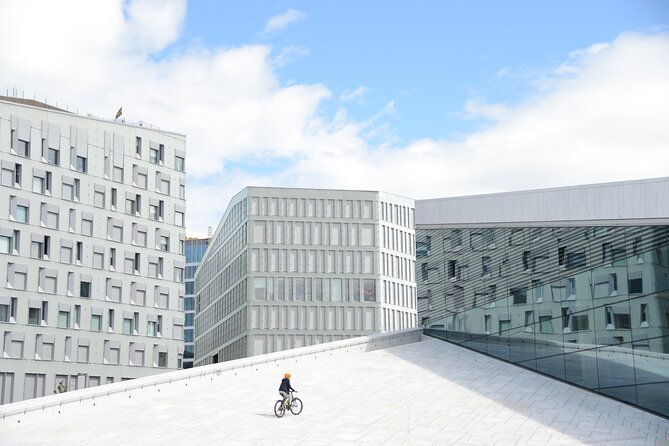
Reviewed · OSLO TOURS
Oslo City Walks: The City of Contrasts
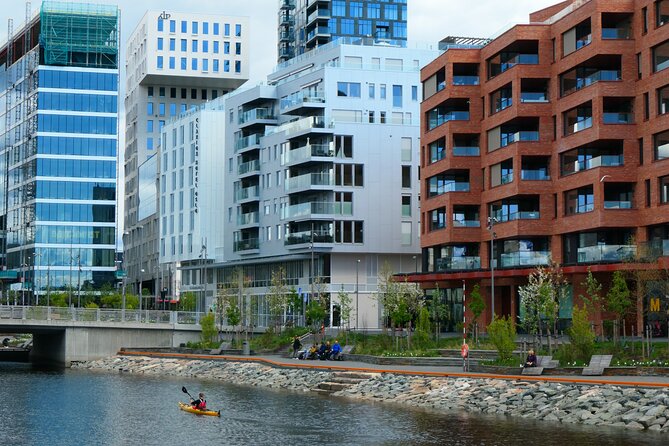
Oslo’s most interesting story is written in its new architecture. This two-hour walk follows the city’s shift from industrial center to modern capital, linking Oslo Central Station, the Acrobat pedestrian bridge, Bjørvika, Bispevika, the Munch Museum, the Opera House, and Deichman Library.
I like the clear route and the chance to see old and new buildings side by side rather than simply ticking off famous sights. I also like that an authorized local guide explains why Oslo has changed so quickly. The tradeoff is simple: this is an architecture and city-development walk, not a greatest-hits tour of Oslo’s major landmarks, and the group size is not specified.
Key points about Oslo’s changing city center
- The Acrobat bridge gives you an immediate view of Oslo in transition, linking Oslo Central Station with the Bjørvika district.
- Bjørvika and Bispevika show modern Oslo at close range, with new buildings replacing former industrial areas.
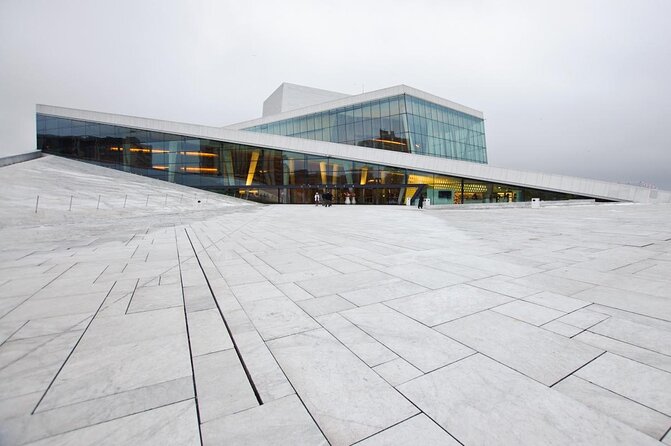
- The Munch Museum, Opera House, and Deichman Library form the modern heart of the route, making this a strong choice for architecture fans.
- An authorized Oslo guide leads the walk in English or Norwegian, adding context that you would miss on a self-guided stroll.
- The two-hour format is easy to fit into a city break, though good walking shoes and weather-ready clothing are important.
- The $52 price is reasonable for a guided city walk, but less attractive if you want interior visits or a long list of classic sights.
Why Oslo’s contrasts make a good walking tour
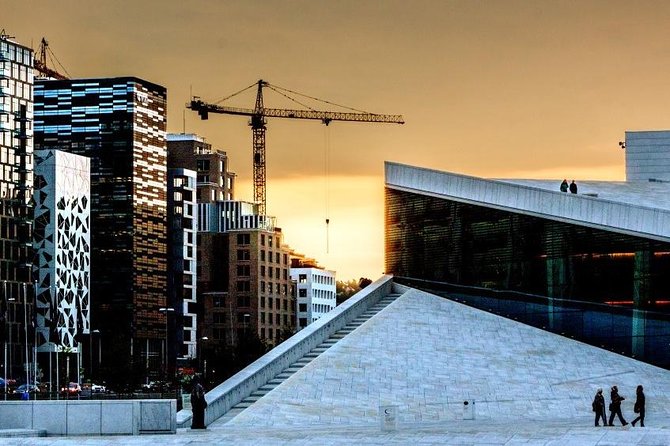
Oslo can feel like two cities at once. Historic parts of the capital sit close to ambitious new construction, and the central waterfront has changed sharply as Oslo has expanded and modernized.
This tour focuses on that change. Rather than spending two hours moving from one famous monument to another, you follow a connected story about industrial growth, urban expansion, transport, public spaces, and contemporary design.
That focus gives the walk a useful purpose. You are not only looking at a new museum or library as an attractive building. You are also hearing how these projects fit into Oslo’s larger effort to reshape its center.
I like tours that explain why a place looks the way it does. Oslo’s new districts can otherwise seem like a collection of striking buildings with no clear connection. An authorized Oslo guide can point out the relationship between the station, the pedestrian bridge, the waterfront neighborhoods, and the cultural buildings at the end of the route.
The experience is also fairly compact. At two hours, it works well on a Monday evening, after a day of sightseeing or before dinner. You get a focused introduction without giving up half a day.
Still, you should choose this walk for its subject, not simply because you want to see Oslo. If your priority is the city’s oldest streets, royal sights, museums, or a broad introduction to Norwegian history, this route may feel narrow.
More City Tours in Oslo
- Oslo: City Sightseeing Hop-On Hop-Off Bus Tour
★ 3.6 · 724 reviews - Oslo: Grand City Sightseeing Tour by Bus with Fjord Cruise
★ 4.6 · 647 reviews - Oslo Combo Tour: Grand City Tour and Oslo Fjord Cruise
★ 4.5 · 555 reviews
Meeting at Østbanehallen beside Oslo Central Station
The walk begins in front of the Oslo Visitor Centre inside Østbanehallen at Jernbanetorget 1. This is a practical meeting point because Oslo Central Station is easy to find, and the hall gives you an indoor place to orient yourself before the start.
Arrive 10 minutes early. The information provided does not name an individual guide, so look for the authorized Oslo guide connected with Oslo Guidebureau AS rather than assuming the tour will begin at the exact station entrance.
Starting here also sets up the theme of the walk. Oslo Central Station is not just a transport hub. It is the point where the older center connects with the newer districts to the east and southeast.
Your guide begins with Oslo’s rapid growth and the forces behind it. Industrialization and city expansion are central to the tour, so expect more explanation of urban change than a standard monument-by-monument commentary.
The meeting point is indoors, but much of the experience takes place outside. Bring a layer that handles changing weather, and wear shoes suited to two hours on foot. High heels are specifically not allowed, and drones are not permitted.
Crossing the Acrobat bridge into Bjørvika
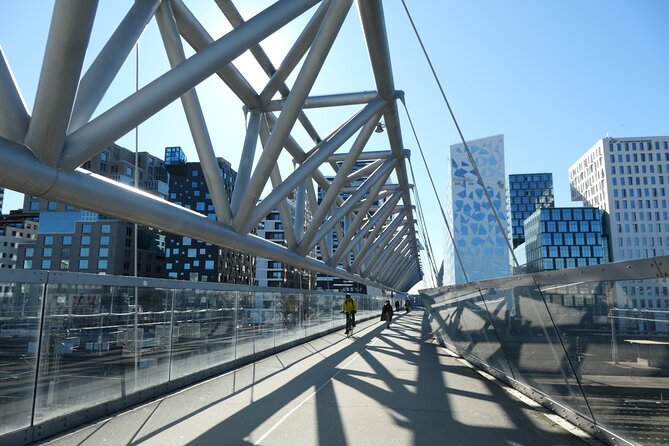
One of the most memorable parts of the route is the walk over the Acrobat pedestrian bridge at Oslo Central Station. The bridge leads into Bjørvika, a district that represents the newer face of Oslo.
Bridges are useful on a city tour because they create a natural pause. From here, you can look at the station area from a different angle and see how pedestrian routes help connect the central city with the redeveloped waterfront.
The name Acrobat gives the bridge a playful identity, but the important point is its function. It carries walkers over the rail area and into a district shaped by recent construction. That change in setting makes the city’s old and new sides easier to compare.
This is also a good place for photographs. The tour description highlights photo opportunities throughout the route, and the bridge should give you a useful view of the surrounding buildings and public spaces.
The drawback is that this part of Oslo is more about current city planning than old-world atmosphere. If you are hoping for cobbled lanes or preserved historic facades, the bridge and surrounding development may seem plain or overly modern.
Reading Oslo’s industrial past in Bjørvika
Bjørvika is the core of the tour’s city-development story. Here, your guide explains how Oslo has changed from an industrial hub into a modern capital with upgraded transport systems, new infrastructure, and growing industries.
The value of this section comes from context. New buildings can be easy to admire and just as easy to forget. When you hear why an area was rebuilt and how it connects to Oslo’s wider growth, the architecture becomes part of a larger civic story.
You should expect to walk through public areas and along streets rather than enter every building. The included service is an authorized guide, not admission to museums or libraries. That distinction matters when you compare this tour with an indoor architecture tour or a museum visit.
Bjørvika is especially suitable for people who like to photograph sharp contrasts in materials, shapes, and age. The old and new buildings provide the visual hook, while the guide supplies the explanation.
The supplied information does not give a detailed list of every building visited, so do not book this expecting a technical survey of individual architects or construction dates. The emphasis is on Oslo’s broader transformation.
A few more Oslo half-days to weigh up
- Oslo: Scenic Fjord Cruise with Audio Guide Commentary
★ 4.5 · 5,375 reviews - Oslo Nature Walks: Island Hopping Tour
★ 4.8 · 2,713 reviews - Oslo: 100% Electric Oslofjord Sightseeing Cruise
★ 4.4 · 2,041 reviews - Oslo: Fjord Evening Cruise with Shrimp Buffet
★ 4.5 · 1,956 reviews
Bispevika and the new Munch Museum
The route continues through Bispevika and passes by the new Munch Museum. This gives you another view of the waterfront’s redevelopment and places one of Oslo’s best-known modern cultural buildings within the walk.
The museum is a highlight from the outside, not a scheduled museum visit. You should not expect time for exhibitions, tickets, or an interior tour during the two-hour walk.
That limitation is not necessarily a problem. The museum helps show how cultural institutions have become part of Oslo’s new waterfront identity. Your guide can explain the building in relation to the district around it, which is more useful than seeing it alone without context.
For photographers, this stretch should be one of the stronger parts of the route. The Munch Museum is visually distinctive, and the surrounding buildings add layers to the scene. The experience gives you time to observe rather than simply stop for a rushed photograph.
The tour’s focus also means that the Munch Museum is not treated as a substitute for visiting the art collection. If Edvard Munch is your main reason for coming to Oslo, plan a separate museum visit.
Finishing beside the Opera House and Deichman Library
The walk ends at Deichman Library, next to the Opera House. This is a fitting finish because the final stop brings together public culture, architecture, and the waterfront redevelopment that defines much of modern Oslo.
The Opera House is one of the city’s best-known modern structures, and its setting makes a strong closing point for a walk about new Oslo. Deichman Library adds another public building to the story, showing that the district is not only about offices or private development.
Ending here gives you a useful choice. You can continue exploring the area on your own, visit the Opera House surroundings, or stop at the library if its opening hours suit your plans. The tour information does not promise entry into either building, so treat the endpoint as a convenient place to continue independently rather than as part of the guided program.
This final section may also answer the criticism that a city walk can feel flat. The route is physically gentle, with no major climb mentioned, but it relies on visual details and commentary rather than dramatic terrain. If you prefer a walk with hills, panoramic viewpoints, or historic fortifications, this will feel restrained.
What the guide adds to the experience
The guide is the main reason to pay for this walk instead of following the route alone. Oslo’s newer districts are easy enough to reach, but their purpose is harder to understand without local explanation.
You can expect commentary in English or Norwegian. The tour is presented as educational sightseeing, with attention to Oslo’s infrastructure, transport systems, industrial growth, and architectural change.
The quality of a city walk depends heavily on delivery. The information available includes a modest overall rating of 3.4 from seven ratings, with some feedback praising the guide, the chance to ask questions, and a comfortable walking pace. Other feedback points to a guide with limited personality and a group that felt too large.
That mixed picture gives you a practical warning. Do not choose this activity mainly for lively entertainment. Choose it if you value a clear explanation of how Oslo developed and you are comfortable with the possibility that the atmosphere may depend on the particular guide and group on your date.
Because the group size is not listed, ask before booking if a small group is important to you. A large group can make it harder to hear commentary, ask questions, or stop easily for photographs.
The $52 price and what you receive
At $52 per person, this is not the cheapest way to see central Oslo. It is also not priced like a full-day private tour or a museum package. The fee covers the two-hour walking experience and an authorized guide, with no attraction admission listed.
I consider the price fair if you want interpretation. Oslo’s new architecture is free to view, and you can cross the Acrobat bridge, walk through Bjørvika, pass the Munch Museum, and reach the Opera House without joining a tour. You are paying for the story, the route, and the chance to ask questions.
The value drops if you mainly want transportation, indoor access, or a long list of sights. You will need to arrange any museum visits separately, and the route does not promise a broad survey of every major Oslo attraction.
The flexible booking terms help. You can cancel up to 24 hours before the tour for a full refund, and the reserve-now, pay-later option lets you hold a place without paying immediately. Check the available start times because the listed departure is associated with a typical Monday evening, while the actual schedule can vary.
Who should choose this Oslo walk
I would recommend this tour to you if you enjoy architecture, public spaces, urban planning, and the way cities change. It also suits a first visit when you want a quick introduction to modern Oslo before exploring the waterfront on your own.
It is a good fit for:
- Visitors with only a short time in Oslo
- People who prefer walking to a bus-based city tour
- Architecture and photography enthusiasts
- Anyone curious about industrial growth and new infrastructure
- Visitors who want a guide-led activity in English or Norwegian
- People who like asking questions during a small or medium-sized walking group
I would be more cautious if you want a traditional historic tour. The route centers on modern development, and the experience may not cover enough older landmarks for someone seeking castles, churches, museums, and preserved streets.
You should also think about the pace and weather. Two hours on foot is manageable for most people who are comfortable walking, but the tour is outdoors and weather-dependent in practical terms. Wear walking shoes and dress for the forecast.
Tips for getting more from the two hours
Read a little about Oslo’s major waterfront buildings before you go, but do not worry about memorizing names. The guide’s explanation will make more sense if you already know that Bjørvika and Bispevika are part of a major city-center transformation.
Bring a phone or camera with enough battery for photographs. The bridge, waterfront districts, Munch Museum, Opera House, and library offer repeated chances to capture the contrast between older structures and new construction.
Keep questions ready. One of the strongest aspects of this tour is the opportunity to ask about the city’s expansion, transport systems, industries, and architectural choices. A question-led walk can feel much more personal than simply listening to a fixed script.
Plan your next stop near Deichman Library or the Opera House. Since the walk ends there, you can continue your evening without returning to the station. The tour details do not specify opening hours or access arrangements, so check those separately if you want to go inside.
Finally, arrive early at Østbanehallen. Oslo Central Station is convenient, but stations can be confusing when you are watching the clock and searching for the Oslo Visitor Centre.
Should you book Oslo City Walks: The City of Contrasts?
Book it if you want a focused explanation of modern Oslo, especially the connection between Oslo Central Station, Bjørvika, Bispevika, the Munch Museum, the Opera House, and Deichman Library.
Skip it if you want a full historic overview, interior museum visits, or a packed list of famous sights. The $52 fee makes sense when the guide’s interpretation is your main goal. Since the rating is mixed and group size is not stated, contact the provider first if you need a small group or a particularly lively guiding style.
For the right audience, this is a useful, compact way to see Oslo as a city still being reshaped. You will not cover everything, but you will come away with a clearer idea of why the center looks so different from one block to the next.
FAQ
Where does the Oslo City Walks tour meet?
Meet your guide in front of the Oslo Visitor Centre inside Østbanehallen at Jernbanetorget 1, 0154 Oslo.
How long does the tour last?
The walking tour lasts approximately two hours.
What time does the tour start?
Starting times vary. Check availability for the date you want to book.
What languages does the guide speak?
The live guide conducts the tour in English or Norwegian.
What is included in the price?
An authorized tour guide is included.
Does the tour include admission to the Munch Museum?
No museum admission is listed. The route passes by the new Munch Museum.
Does the tour enter the Opera House or Deichman Library?
Entry is not listed as part of the activity. The tour concludes at Deichman Library next to the Opera House.
Is the route focused on modern architecture?
Yes. The tour explains Oslo’s modernization, industrial growth, new infrastructure, and the mix of older and contemporary buildings.
What should I wear?
Wear good walking shoes and dress according to the weather. High-heeled shoes are not allowed.
Are drones allowed on the tour?
No. Drones are not allowed.
How early should I arrive?
Arrive at the meeting point 10 minutes before departure.
Can I cancel for a full refund?
Yes. You can cancel up to 24 hours in advance for a full refund.
Can I reserve now and pay later?
Yes. The reserve-now, pay-later option lets you book without paying immediately.
Recently added around Oslo
- The Vigeland Park in Oslo: Insta-Perfect Walk with a Local★ 5.0 · 3 reviews
- Oslo: Best of Oslo Walking Tour and Hop-on Hop-off Bus Tour★ 3.7 · 3 reviews
- Best of Oslo: Walking Tour with a local guide★ 4.6 · 3 reviews
- Afternoon Tea and Classic Concert on the Fjord★ 4.5 · 3 reviews
- Maral Kunst : Jewelry Bar Experience (Jewelry Making)★ 5.0 · 3 reviews
- Lake walk and campfire★ 4.7 · 3 reviews
- Oslo: Yoga & Hiking with a dog★ 5.0 · 3 reviews
- Oslo: Skjennungstoppen Wildlife Forest Hiking Tour★ 5.0 · 3 reviews
Oslo Tours, compared.

Scenic Fjord Cruise with Audio Guide Commentary
Read our review →

Guided Sightseeing Fjord Cruise on Premium Silent Boat
Read our review →
Browse the lists this tour appears in