
Reviewed · OSLO TOURS
Oslo Highlights Private Walking Tour
Oslo’s best feature is its variety, and this tour packs it into five hours: royal buildings, harbor views, public art, a medieval fortress, and the original Fram polar ship. You’ll move from the Nobel Peace Center and Karl Johans gate to Vigeland Park and the Fram Museum, with public transport included.
I like the private format, since your guide can focus on the sights that matter most to your group. I also like the mix of short city-center stops and two longer visits, especially Vigeland’s remarkable sculpture grounds and the ship used in polar exploration. The main drawback is pace: five hours, many stops, and stretches on foot can feel tiring, especially on gravel or unpaved paths.
Key points to know
- Original polar ships: The Fram Museum displays the Fram and Gjøa, two ships tied to Norway’s Arctic and Antarctic expeditions.
- A private itinerary: Only your group participates, allowing some flexibility in emphasis and questions.
- Two substantial visits: Vigeland Park receives about an hour, and the Fram Museum receives another hour.
- Mostly outdoor sightseeing: Central Oslo stops are brief, so expect orientation and exterior views more than long indoor visits.
- Public transport included: The ticket helps connect central Oslo with Vigeland Park and Bygdøy, where the Fram Museum is located.
- A demanding half-day: The route includes plenty of walking, gravel, and unpaved sections, so wear practical shoes.
A five-hour introduction to Oslo’s many sides
This is not a slow museum-and-café outing. It is a brisk private survey of Oslo, designed to show you a large part of the city in one morning or afternoon.
You begin at the Nobel Peace Center by the waterfront and finish at Oslo Central Station, near the Opera House. Along the way, you see the political center, royal quarter, old fortress district, Vigeland’s sculptures, and Norway’s polar exploration story.
That range gives the tour its appeal. In a few hours, you can connect modern Oslo with the city’s royal, civic, artistic, and maritime identity. You also avoid the work of figuring out how to connect these areas yourself.
The tradeoff is depth. Ten minutes at a stop is enough for a clear explanation and photographs, but not enough for a full interior visit. If you want long museum sessions or detailed architectural study, you’ll need extra time before or after the tour.
More Walking Tours in Oslo
- Oslo: Best of Oslo Walking Tour
★ 4.5 · 458 reviews - Oslo: Guided Walking Tour of Central Oslo
★ 4.7 · 438 reviews - Oslo: Historic Myths & Legends Evening Walking Tour
★ 4.8 · 408 reviews
Starting beside the Nobel Peace Center
The meeting point is the Nobel Peace Center at Brynjulf Bulls plass 1. The center occupies a former train station and focuses on the Nobel Peace Prize, which is awarded each year on December 10.
The tour treats this as a short opening stop, with admission listed as free. You may see the building from outside and hear why the prize is such a visible part of Oslo’s identity. The visit sets a civic tone before the route moves toward City Hall.
Do not expect a full museum visit during the ten-minute stop. If the Nobel Peace Center interests you, plan to return on your own. The building is a useful starting point because it places you close to the harbor and several major central sights.
Oslo City Hall and the Nobel ceremony
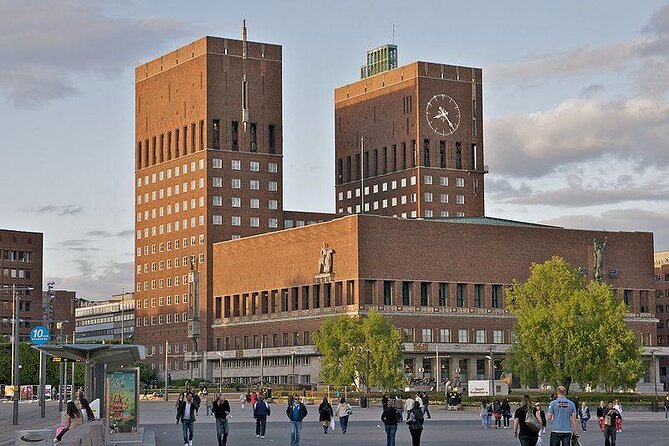
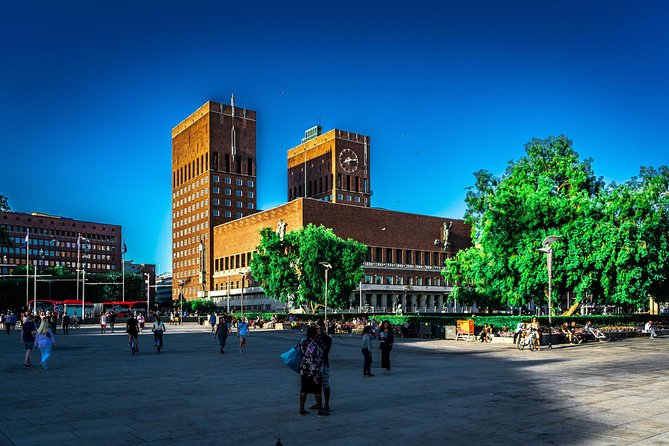
Oslo City Hall is both the seat of local government and the location of the Nobel Peace Prize award ceremony. Its interior is known for artworks showing Norwegian history, culture, and working life.
The scheduled stop lasts about ten minutes and has no admission charge. That makes it a good orientation point, though the limited time may mean a quick look rather than a full inspection of the murals and rooms.
I would pay attention to the guide’s explanation here. City Hall is not simply a municipal office. It is one of the places where Oslo’s local government and Norway’s international peace role meet.
The National Theatre, Palace, and Karl Johans gate
The route then reaches the National Theatre, Norway’s main home for classic and modern Norwegian theater for more than a century. The stop is brief, but it adds cultural context to the royal and political sights nearby.
From there, you walk toward the Royal Palace. The palace is the official residence of the Norwegian monarch, and much of the Royal Court works there. You should think of this as a grounds and exterior visit unless your guide tells you otherwise. The itinerary gives the palace about ten minutes.
Karl Johans gate links several of these important buildings. Oslo’s main pedestrian street runs for about 1,020 meters and is lined with shops, boutiques, and impressive buildings. It is the city’s main public spine, and walking it helps you see how the palace, theater, Parliament, and commercial center fit together.
The Norwegian Parliament, known as Stortinget, sits along Karl Johans gate. The building houses Norway’s national legislature, making this another quick but useful stop. Taken together, the palace, theater, and Parliament show how close Oslo’s cultural and political institutions are to one another.
A different way to spend a day from here:
- Oslo: Scenic Fjord Cruise with Audio Guide Commentary
★ 4.5 · 5,375 reviews - Oslo Nature Walks: Island Hopping Tour
★ 4.8 · 2,713 reviews - Oslo: 100% Electric Oslofjord Sightseeing Cruise
★ 4.4 · 2,041 reviews - Oslo: Fjord Evening Cruise with Shrimp Buffet
★ 4.5 · 1,956 reviews
Akershus Fortress and the old city grid
Akershus Fortress is one of Oslo’s most recognizable landmarks. Set beside the water, it looks across the Oslo Fjord and gives you a sense of the city’s defensive past.
The tour allows about fifteen minutes here. That is enough to see the setting, hear the basic story, and take in the harbor views. It is not enough to explore every part of the fortress complex, so you should treat this as a focused introduction.
The route continues to Bankplassen, or Bank Square. Norway’s central bank once stood here, and the square is associated with Engebret Café, a long-running meeting place linked with well-known Norwegian figures including Henrik Ibsen and Edvard Munch.
Nearby Christiania Torv introduces the older street plan of Kvadraturen, the rectangular quarter created under King Christian IV. The statue of Christian IV’s hand is an unusual small landmark. It is easy to walk past if you do not know the story, which is exactly why a guide helps here.
These central stops are short, but they give the walk texture. You are not only checking off grand buildings. You are also seeing the older street pattern and civic spaces that explain how Oslo developed.
Vigeland Park and Gustav Vigeland’s human figures
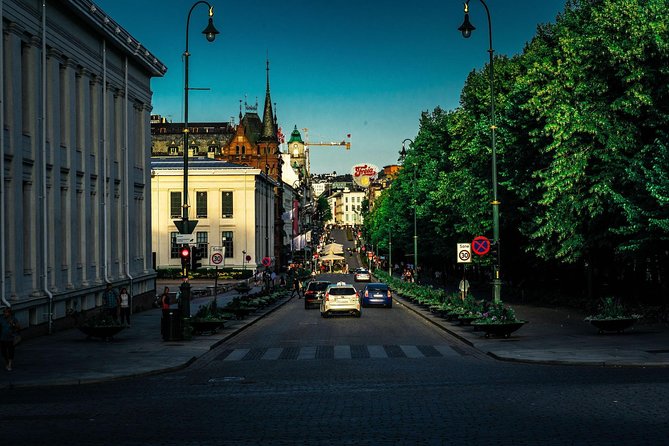
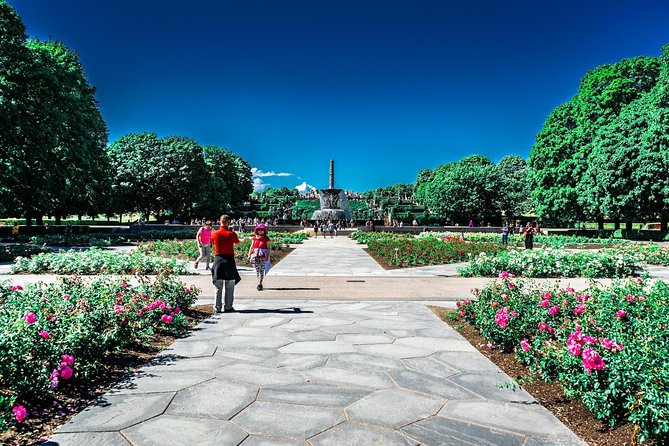
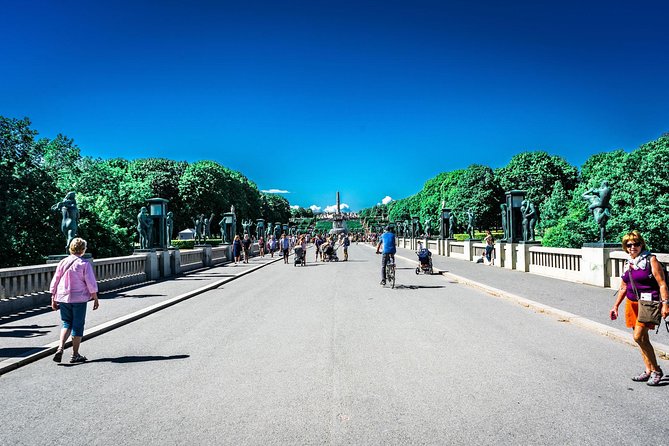
Vigeland Park is the first major stop where the tour slows down. You receive about an hour among more than 200 sculptures created by one artist, Gustav Vigeland.
The park is free to enter, and its scale makes it far more than a quick photo stop. The sculptures show the human body, family relationships, conflict, affection, age, and ordinary life in bold and sometimes strange forms. You can form your own opinion about which figure speaks to you, while the guide explains the artist and the ideas behind the work.
This is one of the strongest parts of the route because the art is outdoors and spread through a formal park. You are not moving from one small gallery room to another. You have space to walk, pause, and compare the sculptures.
The ground is not entirely smooth. Some paths are gravel or unpaved, and the tour’s physical demands increase here. Comfortable shoes matter, especially if the weather is wet.
An hour is a useful amount of time, but it will not cover every sculpture in detail. If Vigeland is your main reason for coming to Oslo, return later for a longer, slower visit. On this tour, the guide’s explanation adds meaning to what can otherwise seem like a collection of unusual statues.
The Fram Museum and Norway’s polar ships
The Fram Museum is the tour’s only clearly included museum admission. It tells the story of Norwegian polar exploration and displays two original ships, the Fram and Gjøa.
The Fram was built for polar expeditions and became closely tied to Norway’s exploration of the Arctic and Antarctic. Gjøa is also displayed in the museum, giving you two original vessels connected with journeys into some of the harshest regions on earth.
An hour here gives you enough time to see the ships and hear the main expedition stories. The attraction works well at the end of the tour because it shifts the focus from Oslo’s streets to Norway’s relationship with the sea, ice, and exploration.
The museum visit is also where the admission fee adds the clearest value. Unlike the many exterior city stops, you have a proper indoor attraction with original objects and ships to examine.
The museum is on Bygdøy, away from the central walking route, so the included public transport is useful. Your guide handles the connection rather than leaving you to work out the route during a tightly timed afternoon.
Seeing the Opera House near the finish
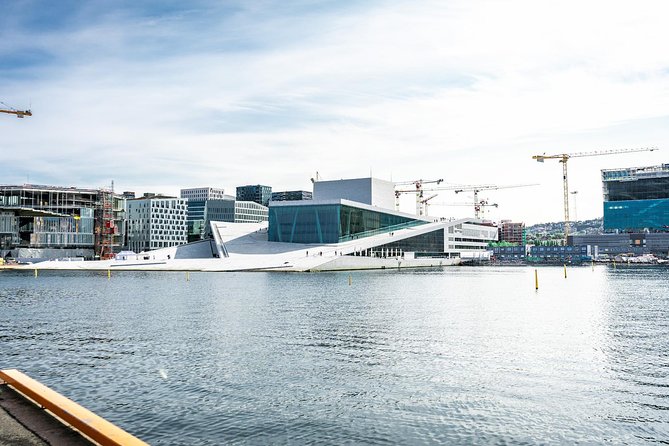
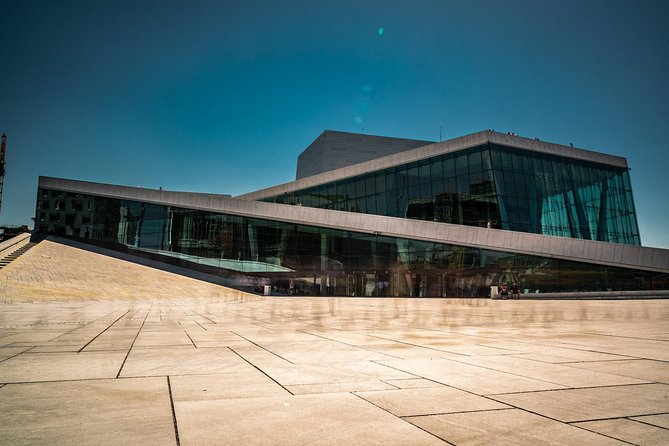
The tour description includes Oslo’s Opera House among its highlights, while the stated end point is Oslo Central Station, close to the Opera House. That means you should clarify with the guide how much time is planned for the Opera House and whether the visit is an exterior stop or a longer look.
The Opera House is an important part of modern Oslo’s waterfront, and its setting near the station makes it easy to visit after the tour. If this building is high on your list, allow extra time at the end rather than assuming the schedule includes a full interior visit.
Finishing at Oslo Central Station is practical. You are near trains, local transport, and the Opera House area, so you can continue sightseeing without retracing your steps.
What the private format adds
This is a private activity, meaning only your group participates. That is helpful when your party has mixed interests. One person can ask about Norwegian monarchs, another can focus on art, and someone else can spend more time on polar exploration.
A guide praised by name in the supplied feedback was Craig, who made sure the group saw the sights most important to them. That is the kind of flexibility a private tour should provide, but guide assignments can change. You should tell the operator what matters to you before the tour begins.
The format also makes communication important. One poor experience described a guide who did not explain the schedule clearly and spoke mainly to one member of a five-person group. That is a useful warning, not a reason to reject the whole experience. At the start, ask for the route, transport plan, and expected timing at each major stop. Make sure the guide addresses the whole group.
Other feedback was strongly positive, especially about friendly, professional guiding and useful advice for the rest of an Oslo stay. A good guide can turn the short city stops into a connected story rather than a string of buildings.
Is $374.81 per person a fair price?
At $374.81 per person, this is an expensive half-day outing. The price makes more sense for a group that wants a private guide and would otherwise spend time arranging transport between central Oslo, Vigeland Park, and Bygdøy.
The fee includes the professional guide, public transport ticket, and Fram Museum admission. Vigeland Park itself is free, as are the listed outdoor stops. Much of what you pay for is the guide’s time, route planning, transport coordination, and the ability to keep the day focused on your group.
For one or two people, the cost may feel high compared with using Oslo’s public transport and visiting free outdoor sights independently. A group discount can improve the calculation for a larger private party, but you should check the final price before booking.
I would choose this tour if you have only one day in Oslo, want an efficient first look, or prefer not to manage directions and transit. I would skip it if you enjoy slow independent wandering and already know you want to spend several hours inside museums.
Timing, fitness, and weather
Plan on about five hours, with roughly an hour at Vigeland Park and an hour at the Fram Museum. The remaining time is divided among many short city stops and transport between locations.
You need a moderate level of physical fitness. The day includes walking across central Oslo, moving through a large sculpture park, and using gravel or unpaved walkways. It is not a good fit if you need frequent seated breaks or want a low-effort sightseeing experience.
The tour operates in all weather. Dress for conditions, and choose shoes that can handle uneven ground. Rain will affect the outdoor portions, especially Vigeland Park and Akershus Fortress, so practical clothing matters more than polished city wear.
Who should book this Oslo tour?
I see this as a strong match for first-time visitors with limited time. You get the major civic sights, royal quarter, fortress, public art, and polar museum in one organized route.
It also suits families or friends who want a private guide and have different priorities. The guide can adjust the conversation and help your group decide where to linger.
Art lovers should value the Vigeland section, while anyone interested in exploration will find the Fram Museum especially rewarding. History fans will appreciate the fortress, Kvadraturen, and the stories attached to Bankplassen.
You may want another plan if your main goal is detailed museum study, relaxed café time, or a gentle stroll. This is a broad introduction, not a slow specialist tour.
Should you book it?
Book this tour if you want a wide Oslo overview in five hours, value a private guide, and like having public transport and a key museum handled for you. Its best moments are the personal scale of the tour, Vigeland Park, and the original ships at the Fram Museum.
Before confirming, ask how the Opera House fits into the schedule and request a clear route briefing at the start. Also be honest about walking ability. If the price fits your group and you want an efficient first look at Oslo, it can save considerable planning time. If you prefer to set your own pace, use public transport independently and spend the difference on longer visits to the places that interest you most.
FAQ
How long does the Oslo Highlights Private Walking Tour last?
The tour lasts approximately five hours.
Where does the tour start?
It starts at the Nobel Peace Center, Brynjulf Bulls plass 1, 0250 Oslo, Norway.
Where does the tour end?
The tour ends at Oslo Central Station, Jernbanetorget 1, 0154 Oslo, close to the Oslo Opera House.
Is the tour private?
Yes. Only your group participates in the activity.
Is public transportation included?
Yes. A public transport ticket is included in the tour price.
Is admission to the Fram Museum included?
Yes. The Fram Museum entrance fee is included.
Do I pay to enter Vigeland Park?
No. Entry to Vigeland Park is free.
What should I wear for the tour?
Dress comfortably and appropriately for the weather. Part of the route uses gravel or unpaved walkways, so practical footwear is recommended.
Recently added around Oslo
- The Vigeland Park in Oslo: Insta-Perfect Walk with a Local★ 5.0 · 3 reviews
- Oslo: Best of Oslo Walking Tour and Hop-on Hop-off Bus Tour★ 3.7 · 3 reviews
- Best of Oslo: Walking Tour with a local guide★ 4.6 · 3 reviews
- Afternoon Tea and Classic Concert on the Fjord★ 4.5 · 3 reviews
- Maral Kunst : Jewelry Bar Experience (Jewelry Making)★ 5.0 · 3 reviews
- Lake walk and campfire★ 4.7 · 3 reviews
- Oslo: Yoga & Hiking with a dog★ 5.0 · 3 reviews
- Oslo: Skjennungstoppen Wildlife Forest Hiking Tour★ 5.0 · 3 reviews
Oslo Tours, compared.

Scenic Fjord Cruise with Audio Guide Commentary
Read our review →

Guided Sightseeing Fjord Cruise on Premium Silent Boat
Read our review →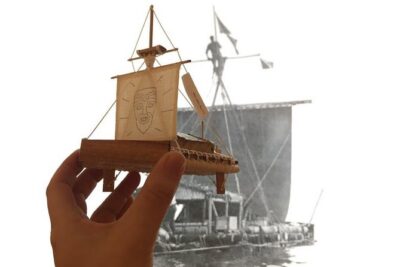
Browse the lists this tour appears in