
Reviewed · OSLO TOURS
Unknown war. Oslo and Norway during 1940-45
Oslo’s wartime story is written into ordinary streets, squares, and government buildings. This private walk with Rami uses period photographs at the places where events happened, turning a sightseeing stroll into a clear account of German occupation, Norwegian resistance, and daily life from 1940 to 1945.
I like the way the tour connects familiar Oslo sights with lesser-known wartime stories. I also like the private format: your group of up to five can ask questions, slow down, or focus more heavily on resistance figures and military history. The main drawback is that it is outdoors, so cold or wet weather can affect the experience.
Key points
- Period photographs at the actual locations help you compare wartime Oslo with the city you see today.
- Rami’s focus on everyday life adds more than dates and military events.
- The private group format lets you shape the pace and subject matter around your interests.
- The route links major central sights from the Royal Palace and Parliament to Akershus Fortress.
- The tour ends near Norway’s Resistance Museum, making it a useful companion to a museum visit.
- The $307.50 group price can be fair for up to five people, especially when shared by a family or small party.
Seeing Oslo through its occupation years
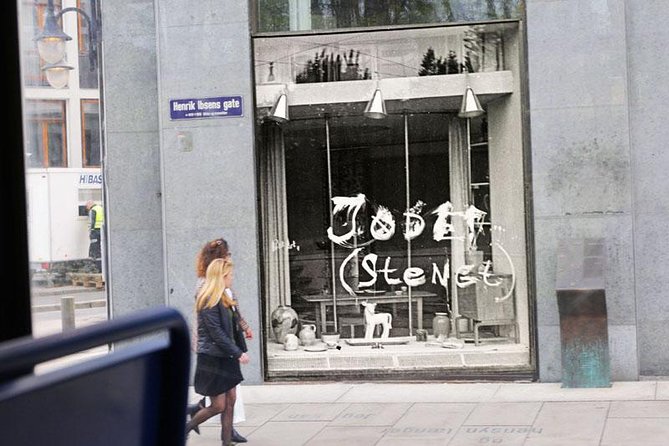
Many visitors first encounter Oslo as a polished capital of palaces, parks, museums, and waterfront views. This walk asks you to look again. A government building becomes a wartime target. A public square carries memories of occupation. A monument recalls the people who resisted German control.
That change in perspective is the tour’s main strength. You are not simply moving from one attraction to another. You are using central Oslo as a map of the war.
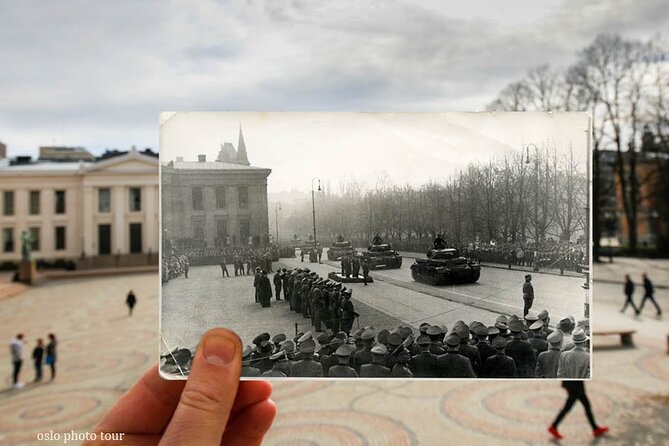
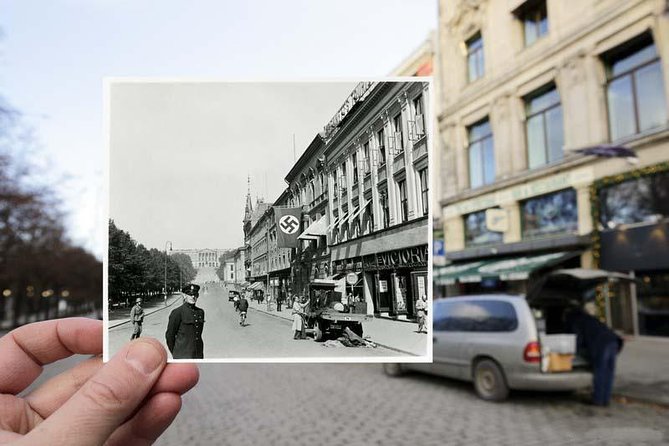
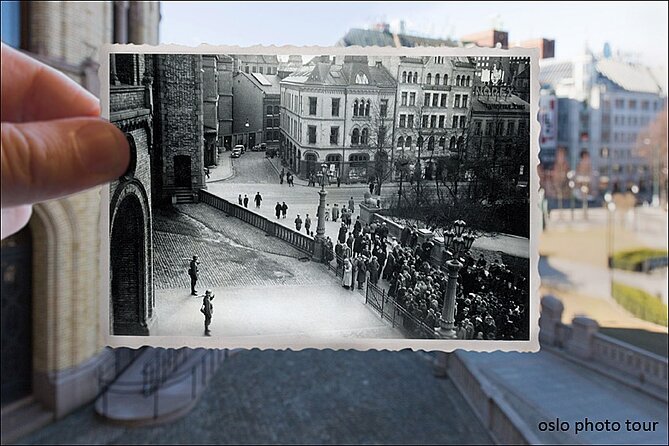
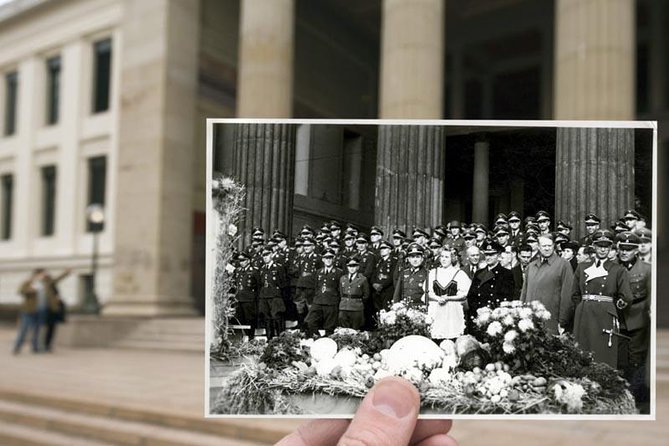
Rami brings a collection of historic photographs and places them beside the modern city. The approach is simple but effective. You stand in the present-day location, then see how it looked during the occupation. The photographs give his stories a fixed point, which makes the history easier to follow and remember.
The tour covers Norway under German occupation, the resistance movement, and the effect of the war on ordinary people. It also places Norway’s wartime role in a wider European setting. The presentation is described as factual and balanced, which suits a subject that can easily become either too military or too sentimental.
A few more Oslo half-days to weigh up
- Oslo: Scenic Fjord Cruise with Audio Guide Commentary
★ 4.5 · 5,375 reviews - Oslo Nature Walks: Island Hopping Tour
★ 4.8 · 2,713 reviews - Oslo: 100% Electric Oslofjord Sightseeing Cruise
★ 4.4 · 2,041 reviews
Starting at the Royal Palace
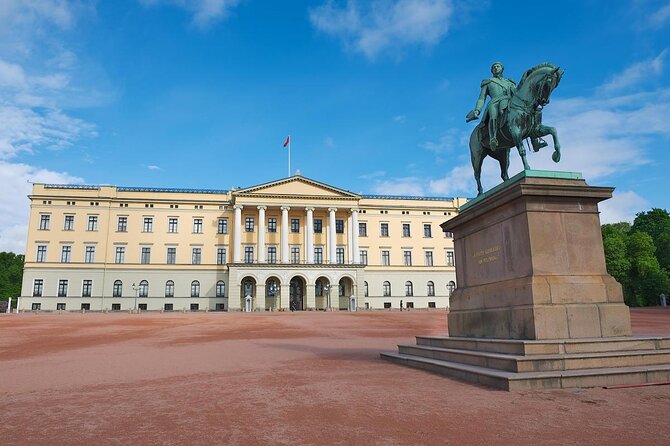
The walk begins at the Karl Johan monument near the Royal Palace. The palace itself is listed as a short stop, and admission is not included, so you should expect to view the site as part of the outdoor route rather than tour the interior.
This is a useful opening point because the palace and the broad central avenue help you get your bearings. Rami can begin building the story of occupied Oslo here, then connect it to the streets and institutions ahead. The setting also gives you an immediate sense of how much of the tour takes place in the center of modern city life.
I would arrive ready for a walking tour rather than a palace visit. If you want to see inside the Royal Palace, that would need to be arranged separately.
Karl Johans Gate and the city under German control
Karl Johans Gate is more than Oslo’s main ceremonial street on this walk. It becomes a series of locations connected with the Second World War. The itinerary allows about ten minutes at this section, though the time is best understood as part of a moving route through several nearby points.
This is where the photo-based method should work particularly well. You can look at a present-day street while Rami shows what stood there or what took place there during the occupation. That contrast helps you see that wartime history does not always survive as a dramatic ruin or a large memorial.
For me, this part of the route offers the most useful kind of city sightseeing. You still see one of Oslo’s central streets, but you also learn how public spaces were used, watched, and remembered during the war.
Parliament and the meaning of national institutions
The Norwegian Parliament is another short outdoor stop. Admission is not included, and the tour information does not promise an interior visit. The value here is the explanation of the institution and its place in Norway’s wartime story.
A stop at Parliament gives Rami a chance to discuss national power, occupation, and the challenge of maintaining Norwegian identity under foreign control. The subject is not treated only as a sequence of battles. The tour also considers decisions, pressure, cooperation, and resistance.
That broader approach is one reason I would recommend the walk to people who already know the basic outline of World War II. You may still learn something new because the focus is on Norway and Oslo rather than the more familiar battlefields of Western Europe.
A different way to spend a day from here:
- Oslo: Fjord Evening Cruise with Shrimp Buffet
★ 4.5 · 1,956 reviews - Oslo: 3-Hour Highlights Bike Tour
★ 4.8 · 1,609 reviews - Oslo: 24 or 48-Hour Hop-On Hop-Off Sightseeing Bus Ticket
★ 4.1 · 1,470 reviews - Oslo: Guided Sightseeing Fjord Cruise on Premium Silent Boat
★ 4.7 · 1,390 reviews
Stortorvet, University Square, and daily life
The route continues through Stortorvet, Oslo’s market square, then to the University of Oslo’s Faculty of Law at University Square. These stops are free to visit and help shift the story away from official buildings and toward public life.
The tour’s attention to ordinary people is one of its most praised features. Rami talks about what life was like for people in Oslo, not only about famous resistance figures. That can include the atmosphere of a city under occupation, the presence of German forces, and the choices faced by Norwegians during those years.
University Square adds another layer. Academic and civic spaces can look calm today, yet they may carry memories of political pressure and wartime events. The value of stopping here is not necessarily a surviving monument. It is the explanation of what the place meant at the time.
I appreciate this part of the itinerary because it prevents the tour from becoming a parade of military names. You get a better sense of how occupation affected a city where people still had to work, study, shop, and make difficult decisions.
Nationaltheatret and Gunnar Sønsteby
Nationaltheatret is the route’s link to the Gunnar Sønsteby monument. Sønsteby is associated with the Norwegian resistance, and the monument gives the walk a clear human focus.
Here, the tour can bring together the larger story of resistance and the personal choices behind it. Rami’s photographs help show the physical setting, while his explanation gives context to the people connected with it. This is also one of the places where a history buff may want to spend extra time asking questions.
The itinerary lists about ten minutes at Nationaltheatret. Since this is a private tour, the advertised stop length may be flexible depending on your group and the guide’s schedule. Still, two and a half hours is a fixed overall frame, so you should tell Rami at the start if resistance history is your priority.
Walking to Akershus Fortress
The tour ends at Akershus Fortress, one of Oslo’s most important historic sites. The route does not include an admission ticket, and the walk ends near Norway’s Resistance Museum rather than promising entry to it.
That arrangement makes practical sense. You receive an outdoor introduction to the occupation and resistance, then you can continue your own visit inside the museum if it fits your plans. One person specifically found the walking tour a strong companion to the museum, since the guide had already placed many events and locations in context.
I would plan the fortress visit separately and check its opening arrangements before booking the day. The tour’s listed operating window is Monday through Thursday, from 9:00 a.m. to 4:00 p.m., with dates shown through August 2026. Since the information provided does not include museum admission or a full museum schedule, treat the indoor visit as an extra part of your Oslo plan.
Why the photographs matter
The period photographs are not a decorative extra. They are the tool that makes the route work.
Without them, several stops could feel like standard city landmarks with a short wartime note attached. With them, you can compare the same buildings and streets across time. The visual link gives Rami’s explanations more weight and helps you understand that many of the places connected with the occupation are still part of everyday Oslo.
The photos also support the tour’s balanced tone. Instead of relying only on dramatic storytelling, Rami can show you the setting and explain what happened there. That approach is especially useful for families, first-time visitors to Oslo, and anyone whose knowledge of Norway during World War II is limited.
The tour has been praised for being easy to follow and for using facts rather than pushing a political message. That does not make the subject dry. It gives you room to think about the difficult choices and competing pressures of the period.
A private walk for up to five people
The price is $307.50 per group, with up to five people included. For one or two people, that is a sizable cost for a two-and-a-half-hour walk. For four or five people, the per-person price becomes much more reasonable, especially if you value a private guide and the ability to ask questions throughout.
The private setup is important here. A large group would make it harder to see the photographs, hear every explanation, or stop when a particular subject catches your interest. With your own group, you can ask for more detail about resistance activity, daily life, Norwegian culture, or the city itself.
The guide has also shown flexibility with timing and personal needs. That does not remove the formal cancellation rules, but it suggests that communication matters. Contact the provider promptly if your schedule changes rather than waiting until the last minute.
The tour is offered in English and uses a mobile ticket. Confirmation is sent within 48 hours, subject to availability. It is listed as suitable for most people, and service animals are allowed.
How to prepare for the weather and pace
This is an outdoor walking tour. Rain has affected some visits, and even a cold day has not prevented the tour from going ahead when conditions allowed. Bring an umbrella or rain jacket, and wear shoes suited to city walking.
The route includes several short stops, but the experience is not seven isolated ten-minute talks. You will walk between the locations, with the story developing as you move through central Oslo. If someone in your group has trouble hearing while walking, say so early. One family found that Rami was willing to clarify and answer questions, but moving city streets can still make listening harder for some people.
A private tour is not automatically a slow tour. If you want long pauses at the monument or extra discussion at one site, mention that at the start. The advertised duration is approximately two hours and thirty minutes, so the guide must balance your requests with the full route.
Who will get the most from this tour
I would choose this walk if you have a real interest in World War II, Norwegian resistance, or the way national history appears in an ordinary city. It also suits families with older children and teenagers who learn better from stories, photographs, and real places than from a museum label.
You do not need to be a specialist. The tour begins with the city itself, so it works well as an introduction to Oslo. Several people have also used films about Norway during the war as background before taking the walk. That can help, but it is not required.
Cruise passengers may find the private format useful because the route covers several major central sights in a set period. It can serve as both a city orientation and a focused history tour. If you have already taken a general Oslo sightseeing tour, this offers a different way to understand the same center.
I would not choose it if you want extensive interior visits, a bus ride, or a relaxed café-style afternoon. Most stops are short, admission is not included, and the main content comes from walking and listening outdoors.
Booking value and final advice
The tour is often booked well ahead, with an average lead time of 77 days. That suggests planning early if you have fixed dates, especially since the listed schedule is limited to Monday through Thursday during the stated operating period.
You can cancel for a full refund up to 24 hours before the start time. Cancellations or changes inside that window are not accepted for a refund. Poor weather or failure to reach the minimum number of participants can lead to a new date, another experience, or a full refund.
I would book this tour if you want Oslo’s wartime story tied to real streets and buildings, and if your group can share the cost. Rami’s period photographs, clear explanations, and focus on both resistance figures and everyday life give the walk more substance than a standard city overview.
Skip it if your priority is entering every major attraction or staying indoors. For the right visitor, this is a focused, personal way to see Oslo and understand how the occupation shaped the city from 1940 to 1945.
FAQ
Where does the tour begin?
The tour begins at the Karl Johan monument in central Oslo, at Karl Johan-monumentet, Sentrum, 0010 Oslo.
Where does the tour end?
The walk ends at Akershus Fortress, near Norway’s Resistance Museum, at 0150 Oslo.
How long does the tour last?
The tour lasts approximately two hours and thirty minutes.
How many people can join?
This is a private activity for your group, with up to five people included in the listed price.
What language is offered?
The tour is offered in English.
Is admission to the attractions included?
Admission tickets are not included for the Royal Palace, Parliament, Nationaltheatret, or Akershus Fortress. The stops at Stortorvet and University Square are listed as free.
Does the tour enter Norway’s Resistance Museum?
The walk ends near Norway’s Resistance Museum, but museum admission and an indoor museum visit are not included in the stated experience.
Is the tour suitable in bad weather?
The experience requires good weather. If it is canceled because of poor weather, you can choose another date or receive a full refund. Since the tour is outdoors, bring rain protection when the forecast looks uncertain.
What is the cancellation policy?
You can cancel at least 24 hours before the local start time for a full refund. Changes or cancellations made less than 24 hours before the start time are not accepted.
Recently added around Oslo
- The Vigeland Park in Oslo: Insta-Perfect Walk with a Local★ 5.0 · 3 reviews
- Oslo: Best of Oslo Walking Tour and Hop-on Hop-off Bus Tour★ 3.7 · 3 reviews
- Best of Oslo: Walking Tour with a local guide★ 4.6 · 3 reviews
- Afternoon Tea and Classic Concert on the Fjord★ 4.5 · 3 reviews
- Maral Kunst : Jewelry Bar Experience (Jewelry Making)★ 5.0 · 3 reviews
- Lake walk and campfire★ 4.7 · 3 reviews
- Oslo: Yoga & Hiking with a dog★ 5.0 · 3 reviews
- Oslo: Skjennungstoppen Wildlife Forest Hiking Tour★ 5.0 · 3 reviews
Oslo Tours, compared.

Scenic Fjord Cruise with Audio Guide Commentary
Read our review →


Guided Sightseeing Fjord Cruise on Premium Silent Boat
Read our review →
Browse the lists this tour appears in