
Reviewed · BERGEN TOURS
The influence of Bergen in Norway’s development, city tour
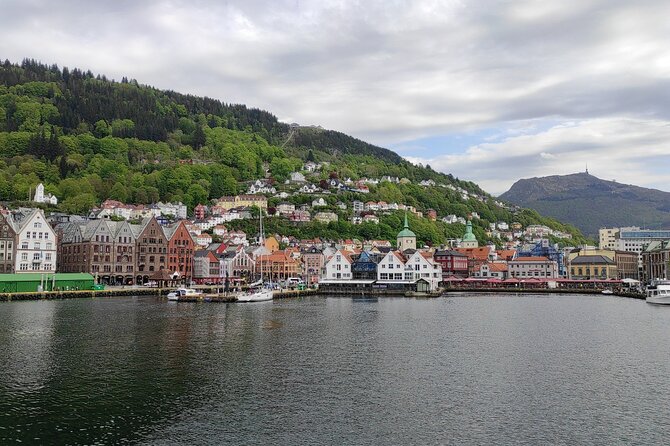
Bergen’s story comes into focus on foot, from the theater that signaled social change to the timber warehouses where Scandinavian trade once ran the city. This two-hour walking tour links culture, commerce, and royal power in a compact route ending at Bergenhus Fortress.
I like the clear route from the National Stage to Håkon’s Hall, and I like that the guide explains what each place meant to ordinary society, not just when it was built. The English presentation, mobile ticket, and central meeting point also make this an easy first look at Bergen.
The main consideration is pace. You cover five stops in about two hours, and the National Stage, Torgallmenningen, and Fish Market are mainly outdoor explanation points. Entry to the fortress area is included, but the palace and tower museums cost about €17 extra.
Key points to know before booking
- The route connects five central sights: Start at Den nasjonale scene and finish at Håkon’s Hall in Bergenhus Fortress.
- The National Stage adds a social angle: You learn how theater reflected changing ideas in Bergen, rather than simply passing an attractive building.
- Bryggen gets proper context: The guide explains how Hanseatic merchants worked and lived along the wharf.
- The Fish Market links Bergen to its oldest trade: The stop places the city’s seafood tradition within more than seven centuries of local life.
- The fortress visit is included, but museum entry is not: Plan for roughly €17 if you want both the palace and tower museums.
- Omar is one named guide: The guide is described as discreet, punctual, efficient, helpful, and well-informed.
A walking route through Bergen’s changing identity
This is not a museum-heavy tour. It is a guided orientation walk that uses major city landmarks to explain how Bergen developed.
That distinction matters. You are not promised long visits inside every building. Instead, you get a connected story about theater, civic space, trade, religion, monarchy, and the sea. If you have only one day in Bergen, this route can help you decide where to spend more time afterward.
The tour is offered in English and lasts about two hours. The route begins at Engen 1, outside Den nasjonale scene, and ends at Håkon’s Hall in Bergenhus Fortress. If your meeting point is the port of Jekteviken, the final stop is Bergen Fortress instead.
The route is central and near public transportation. Most people can take part, and service animals are allowed. The maximum group size is listed as 200, so the actual feel may depend on how many bookings arrive for your date. A group of that size would make it harder to hear and ask questions, so this is worth keeping in mind if you prefer a quiet, intimate walk.
More City Tours in Bergen
- Bergen: City Tour on Foot
★ 4.9 · 1,327 reviews - Bergen: City Sightseeing Hop-On Hop-Off Bus Tour
★ 3.8 · 481 reviews - City Walking Tour – Bergen On Foot
★ 5.0 · 436 reviews
Den nasjonale scene and Bergen’s social change
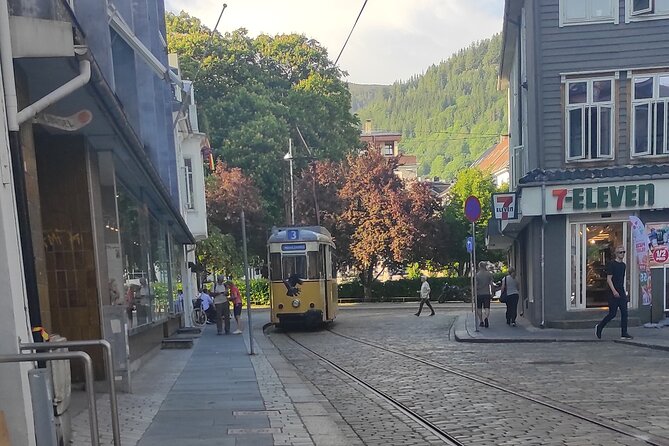
The first stop is Den nasjonale scene, Bergen’s main theater. You see the building from the outside, then hear why the creation of a major theater mattered to the society of its time.
This gives the tour an unusual opening. Many city walks begin with a monument, a church, or a famous view. Here, the story starts with public culture. A theater is not only a place for performances. It can signal who has access to education, art, language, and public debate.
The stop takes about 20 minutes, including the explanation and the walk toward the next point. Do not expect to spend 20 minutes touring the interior. The building itself is the visual reference, while the guide supplies the social and cultural meaning.
I like this approach because it gives Bergen a human beginning. You are introduced to the city as a place shaped by changing public ideas, not only by merchants and kings. If architecture is your main interest, the outside-only format may feel brief. If you enjoy learning why a building mattered, this is a strong start.
One guide associated with the experience is Omar. His style is described as punctual, discreet, efficient, helpful, and well-informed. Since guide assignments can vary, you should not assume Omar will lead every departure, but his mention suggests that the experience can have a personal touch rather than feeling like a simple point-to-point transfer.
Torgallmenningen, Bergen’s central meeting place
The walk continues to Torgallmenningen, the central square. This is where the guide places Bergen on a citywide scale.
A central square is useful early in a walking tour because it helps you understand how the streets, commercial areas, and public spaces relate to one another. The guide uses the square as a reference point for explaining Bergen in more detail.
The stop lasts about 20 minutes. Again, this is mainly an outdoor talk rather than a formal admission visit. You will want comfortable shoes, since the value comes from moving through the city and listening as the setting changes around you.
I see this stop as the tour’s orientation point. The National Stage shows social change through culture. Torgallmenningen shows how public space brings the city together. The two stops create a useful contrast before the walk turns toward Bergen’s famous waterfront trade.
If you have already spent several days exploring central Bergen, some of this explanation may repeat what you know. For a first visit, though, the square helps turn separate sights into one connected city story.
The Fish Market and seven centuries of trade
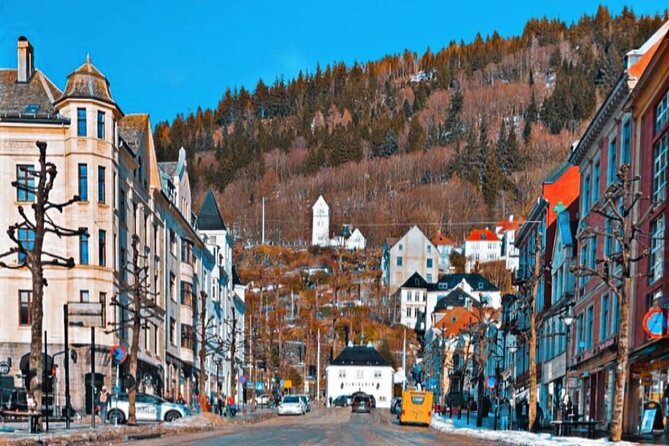
The Fish Market is one of Bergen’s best-known traditional attractions, and the tour gives it about 20 minutes.
The important point is not only what is sold there today. The market represents the city’s long relationship with fishing, shipping, and food trade. Its tradition reaches back more than seven centuries, making it a natural bridge between Bergen’s daily life and its economic past.
You will learn how the market fits into the city’s development rather than simply stopping for a photo. That makes the visit more useful if you are trying to understand why Bergen became such an important port.
The stop is short, so do not expect time for a leisurely meal or a full market browse during the guided portion. If you want to look at stalls, eat seafood, or compare prices, plan to return later on your own. The tour’s job here is explanation and orientation.
This is one of the places where the guide’s broader theme works well. Bergen’s identity was shaped by what could be brought in, sold, preserved, and shipped out. The market makes that story tangible without requiring a long museum visit.
A few more Bergen half-days to weigh up
- From Bergen: The Original Fjord Cruise to Mostraumen
★ 4.7 · 8,440 reviews - Bergen: Mostraumen Fjord & Waterfall Cruise
★ 4.6 · 2,990 reviews - Bergen: Past & Present Small Group Guided Walking Tour
★ 4.9 · 1,609 reviews - Walking Tour in Bergen of the Past and Present
★ 5.0 · 1,575 reviews
Bryggen and the working world of the Hanseatic Wharf
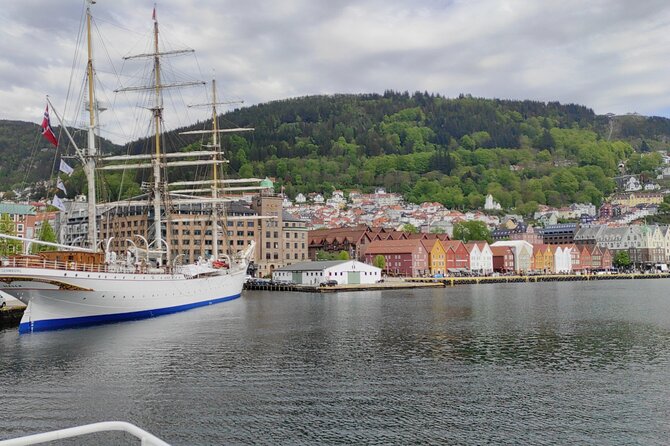
Bryggen Hanseatic Wharf receives the longest stop, about 30 minutes. That is appropriate. This waterfront district is a UNESCO World Heritage site and one of Bergen’s defining places.
The guide explains the businesses carried out here for centuries and the working conditions of the merchants who lived along the wharf. The emphasis is not just on handsome timber facades. You get a closer look at the commercial system behind them, including the role of fishermen and merchants from across Scandinavia.
That practical focus is the strongest part of the route for many people. Bryggen can look like a picturesque row of wooden buildings, but the story becomes more interesting when you consider it as a workplace, storage area, and home. The merchants were not standing outside for photographs. They were handling goods, negotiating deals, and living within a tightly organized trading environment.
Thirty minutes is enough for a solid explanation and a walk between points, but it is not enough for an exhaustive study of every alley and building. The guide will help you notice the main ideas. You can then return independently if you want more time with the architecture.
I especially like that the tour explains working conditions. That detail shifts the focus from postcard scenery to real urban life. Bryggen becomes a place of labor and commerce, not merely one of Bergen’s prettiest views.
Because this is an outdoor stop, weather can shape the experience. Bergen is known for wet conditions, and the supplied details do not promise indoor shelter or weather cancellation. Bring suitable clothing and shoes, particularly if you are visiting during a rainy spell.
Bergenhus Fortress and Håkon’s Hall
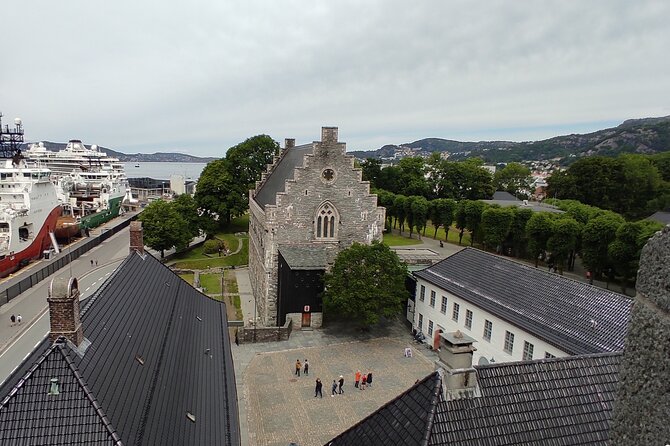
The final stop is Bergenhus Fortress, where you spend about 30 minutes. This is the tour’s move from commercial power to royal power.
The fortress was a residence of Nordic kings, and the guide explains the shift from Viking culture toward Christianity. Håkon’s Hall is described as Bergen’s most enigmatic medieval building, which gives this stop a strong historical finish.
The group enters the fortress area and receives an explanation of its importance. However, admission to the palace or tower museums is not part of the tour. The combined price is about €17 for both museums.
That extra cost is easy to understand, but you should budget for it before booking. The guided experience gives you the setting and the context. The museum tickets let you continue inside at your own expense. If you are watching every euro, you can still finish the walking tour without paying for the museums. If medieval buildings and royal history are high on your list, the additional entry will likely be worthwhile.
Ending at Håkon’s Hall also gives the route a clear shape. You begin with a modern cultural institution, pass through the civic center and old market, study the commercial waterfront, and finish with a royal and religious center. That sequence explains Bergen’s development as a series of changing powers rather than a collection of unrelated sights.
The final location is useful for the rest of your day. You can remain in the fortress area, continue exploring nearby, or use local transportation from the central part of town. The tour does not include a return transfer to the starting point, so plan your onward route before you set out.
What the $45.66 price gives you
At $45.66 per person, this is not the cheapest way to simply see Bergen’s landmarks. You could walk past several of these places on your own for free.
The value comes from the guide’s interpretation. You are paying for a two-hour explanation that links the theater, public square, market, wharf, and fortress into one story. That is useful when you want context quickly, especially at the start of a short stay.
The price also makes more sense if you would otherwise pay for a separate city orientation, museum guide, or private research time. The route covers several central sights without charging admission at the five listed stops. The museum entry at Bergenhus is separate, so treat the advertised price as the cost of the guided walk, not a full package of indoor visits.
I would consider it good value for a first day in Bergen, particularly if you want help deciding where to return. I would be less enthusiastic about it for someone who has already studied Bryggen, the Fish Market, and Bergenhus in detail.
The group limit of 200 is the main value concern. A small group can make the explanations feel personal. A very large group may feel more like a moving lecture, especially at busy public sites. The data does not give an average group size, so you should book with that uncertainty in mind.
Who will get the most from this walk
This tour suits you best if you want a broad introduction rather than a specialist visit to one building.
It is a good match for:
- First-time visitors who want the city’s main central landmarks explained in one walk
- People interested in how trade, theater, religion, and royal power shaped Bergen
- Cruise passengers or short-stay visitors who need a compact route
- Anyone who prefers outdoor sightseeing to spending two hours inside museums
- Visitors who want an English-speaking guide and mobile ticketing
It may be less suitable if you need extensive interior access, a slow photography walk, or a small-group guarantee. The National Stage and Fish Market stops are short, and the palace and tower museums at the fortress cost extra.
You should also consider your walking comfort. The tour is on foot for about two hours, and the supplied details do not specify the total distance or the surface conditions. Most people can participate, but comfortable footwear remains sensible.
Timing, meeting point, and cancellation
The listed starting point is Den nasjonale scene, Engen 1, Bergen. The normal ending point is Håkon’s Hall, Bergenhus Fortress, at Bergenhus 10. If the tour starts at Jekteviken port, the ending point is Bergen Fortress.
Confirmation arrives when you book. The activity is offered in English, includes a mobile ticket, and operates near public transportation.
Free cancellation is available if you cancel at least 24 hours before the start time. Cancellations or changes made inside that window are not accepted for a refund. The operator also requires a minimum number of participants. If that minimum is not reached and the tour is canceled, you are offered another date or experience, or a full refund.
The tour is often booked about 20 days ahead. That does not guarantee that every date sells out, but it is a useful sign that you should not leave planning until the last minute if your schedule is fixed.
Should you book the Bergen city tour?
Book it if you want a fast, thoughtful introduction to Bergen and enjoy hearing how places worked, not just when they were built. The route is especially helpful on a first visit because it links the city’s theater, market, waterfront, and fortress in a logical order.
I would book it early in a multi-day stay, then return to Bryggen, the Fish Market, or Bergenhus for a closer look. If you have only a few hours in port, check the meeting point carefully and allow enough time to reach the start.
Skip it if your priority is full museum access or a quiet private walk. You will need to pay extra for the palace and tower museums, and a maximum group size of 200 means the atmosphere may not always be intimate.
For most first-time visitors, the $45.66 cost is fair for the structure and explanation, provided you understand what you are buying: a guided outdoor city walk with fortress access, not a series of lengthy indoor tours.
FAQ
How long does the Bergen city tour last?
The tour lasts approximately two hours.
Where does the tour begin?
The standard meeting point is Den nasjonale scene, Engen 1, Bergen, Norway.
Where does the tour end?
The usual ending point is Håkon’s Hall at Bergenhus Fortress, Bergenhus 10. If the tour begins at Jekteviken port, it ends at Bergen Fortress.
Is the tour offered in English?
Yes. The experience is offered in English.
Are admission tickets included?
The guided tour includes access to the fortress area, but entry to the palace or tower museums is not included. Admission for both museums is about €17.
What sights are included in the route?
The route includes Den nasjonale scene, Torgallmenningen, the Fish Market, Bryggen Hanseatic Wharf, and Håkon’s Hall at Bergenhus Fortress.
Can I cancel for a full refund?
Yes, if you cancel at least 24 hours before the experience starts. Cancellations or changes made less than 24 hours before the start time are not accepted for a refund.
Recently added around Bergen
- Arrival Private Transfer from Bergen Airport BGO to Bergen by luxury minivan★ 5.0 · 3 reviews
- Private Day Tour- Flam Railway & Fjord Cruise From Bergen★ 5.0 · 3 reviews
- Trolltunga Helicopter & Waterfalss Sightseeing From Bergen★ 5.0 · 3 reviews
- Three-summit hike in Bergen★ 5.0 · 3 reviews
- From Bergen: Modalen Private Fjord Cruise with Waterfalls★ 5.0 · 3 reviews
- PRIVATE GUIDED TOUR: Norway’s Highlights – Viking Special, 11-12 hours – WINTER★ 5.0 · 3 reviews
- Fangene på Fortet Bergen: Prison Island Adventure Escapegame★ 5.0 · 3 reviews
- Bergen to Hardangerfjord VIP car + private yacht Fjord cruise★ 5.0 · 3 reviews
Bergen Tours, compared.
Past & Present Small Group Guided Walking Tour
Read our review →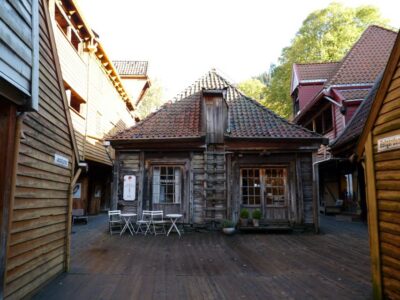
Viking Village, Nærøyfjord Cruise & Flåm Railway
Read our review →
Guided Tour To Nærøyfjorden, Flåm And Stegastein – Viewpoint Cruise
Read our review →

Browse the lists this tour appears in