
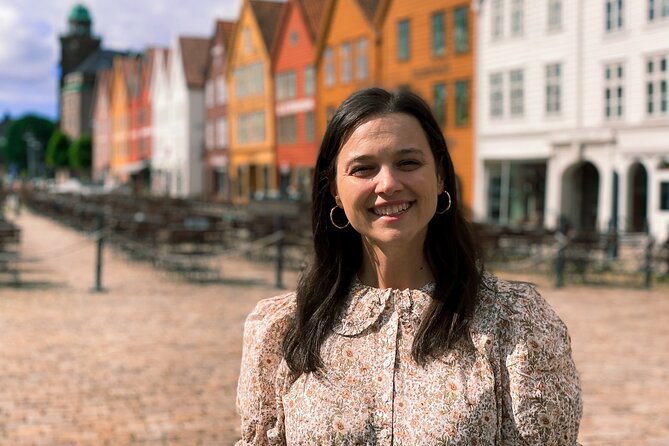
Reviewed · BERGEN TOURS
Walking Tour in Bergen of the Past and Present
Bergen’s story comes into focus along its waterfront, where medieval kings, German merchants, wooden houses, and modern food culture all meet within a short walk. This two-hour route moves from Bergenhus Fortress and Håkon’s Hall through UNESCO-listed Bryggen, then climbs into old residential lanes before ending near the Fish Market.
I like the way the tour joins big history with ordinary life. You hear about Norway’s royal past and the Hanseatic League, then get practical talk about taxes, housing, food, work, hiking, and where to eat. I also like the small maximum of 16 people, which gives guides such as Jeff, Janine, Dane, Emma, Magda, Anaïs, Erik, Neil, and Eriik room to answer questions.
The main drawback is that this is an outdoor overview, not a museum visit. You do not enter Håkon’s Hall, St. Mary’s Church, or the Bryggen buildings, and the walk includes uneven cobblestones plus an uphill section toward Fjellsiden.
Key points at a glance
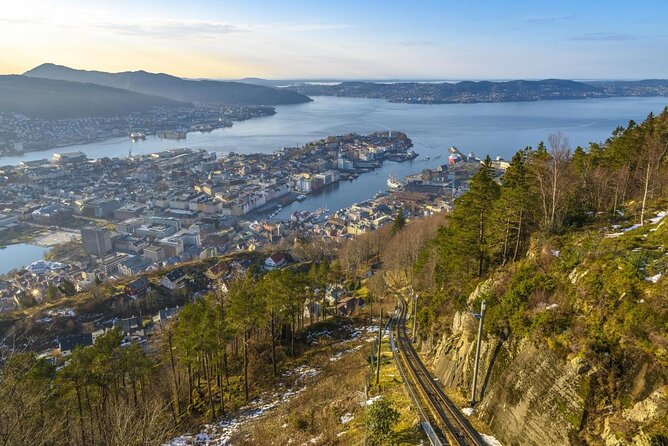
- Bergen’s medieval center in two hours: Connect the fortress, royal hall, Bryggen wharf, oldest church, wooden lanes, and Fish Market in one compact route.
- A local view of modern Norway: The second half covers food, taxes, housing, working life, hiking, and everyday customs.
- Small group format: The tour has a maximum of 16 people, with occasional private or nearly private departures.
- Bryggen without a museum ticket: You explore its lanes and trading story from outside, with no extra admission fee.
- A useful first-day tour: Finish near the tourist office, ready to plan meals, museums, the funicular, and the rest of your stay.
- A moderate walking challenge: Expect cobblestones and an uphill walk, so sturdy shoes and reasonable fitness matter.
Starting at Bergenhus Fortress
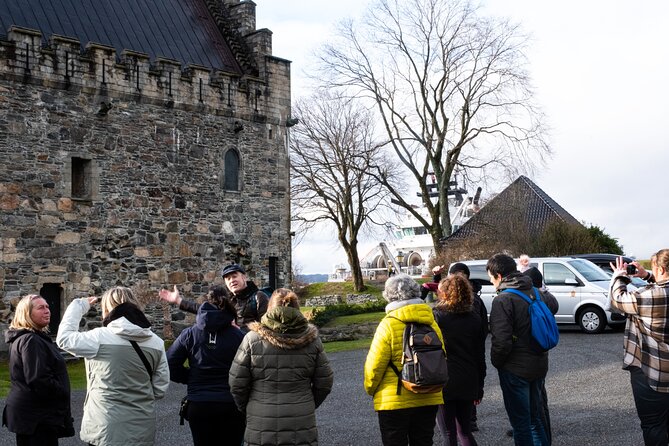
The tour begins at Bradbenken 1, near Bergenhus Fortress and close to public transportation. This is a smart starting point because Bergen’s political story begins here, not simply at the colorful waterfront.
When Bergen served as Norway’s capital, the fortress area held the royal palace. Your guide uses the setting to explain how power worked in medieval Bergen and why this harbor mattered so much. You are not just looking at old stone and defensive walls. You are standing where the city’s rulers once lived and governed.
The outdoor setting makes the history easy to place. Instead of hearing a string of dates in a classroom-like setting, you can connect the royal past to the buildings around you. Guides are encouraged to tell the story in a personal, conversational way, and the best ones, including Jeff and Dane, add local anecdotes and invite questions as they walk.
The fortress can occasionally close for a private event. If that happens, the route may need to change, so this is worth keeping in mind if you have a tightly packed schedule.
More Walking Tours in Bergen
- Bergen: Past & Present Small Group Guided Walking Tour
★ 4.9 · 1,609 reviews - City Walking Tour – Bergen On Foot
★ 5.0 · 436 reviews - Bergen: Sightseeing Walking Tour with Ferry Ride
★ 4.9 · 296 reviews
Håkon’s Hall and Norway’s complicated past
From the fortress, you pass Håkon’s Hall, the largest surviving part of Bergen’s medieval palace. The building gives the guide a natural way to explain Bergen’s period as an independent country, followed by Norway’s unions with Denmark and Sweden.
That political background matters because Bergen’s history is not only a local story. The city’s fortunes were tied to shifting royal power, trade routes, and the changing status of Norway itself. A good guide makes those changes clear without turning the walk into a lecture.
You will not go inside Håkon’s Hall. It is a paid museum, and admission is not part of the tour. If medieval interiors interest you, you can return later on your own, but keep your museum visit separate from this experience.
This is one of the tour’s useful features. You get a clear introduction to the building and its place in Norwegian history without paying for several separate attractions during the walk. The tradeoff is simple: you see the exterior and hear the story, but you do not examine the interior.
Walking through Bryggen’s Hanseatic lanes
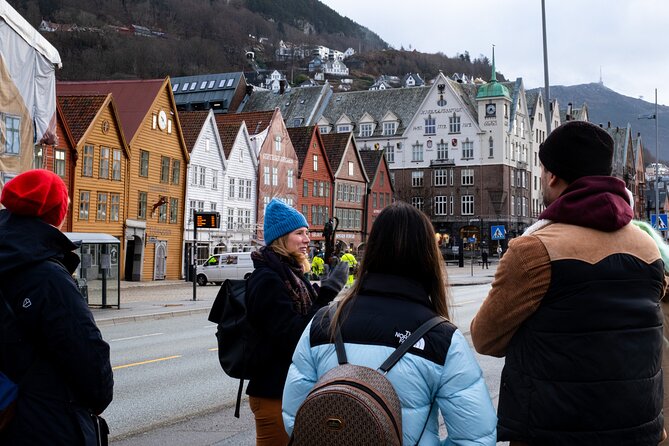
The route then reaches Bryggen, Bergen’s UNESCO World Heritage site and the best-known part of the city. Merchants have traded here for about 1,000 years, with the German Hanseatic League playing the central role in Bryggen’s success.
This is where the walk becomes especially visual. The narrow wooden passages and leaning facades make it easy to picture a working wharf rather than a polished modern attraction. Your guide explains how the Hanseatic merchants organized trade, how their systems worked, and how the wharf functioned as a commercial center.
I find this kind of explanation more useful than simply taking photographs of colorful buildings. You learn why the buildings look the way they do and what took place inside them. The Hanseatic merchants were not just shopkeepers. They operated within a strict trading network, and Bryggen worked because that network connected Bergen with wider European commerce.
You remain outside the buildings. Today they contain shops and small businesses, not museums, so the tour does not include interior visits. The 40-minute stop is long enough to explore the passageways and ask questions, but not so long that the route gets stuck in one attraction.
Allow time to look up and around. Bryggen’s charm is found in its crooked lines, tight alleys, and changing views between the buildings. Cobblestones can be uneven, and the narrow lanes may require slower walking. Comfortable shoes will make this part much easier.
St. Mary’s Church and the city’s oldest surviving building
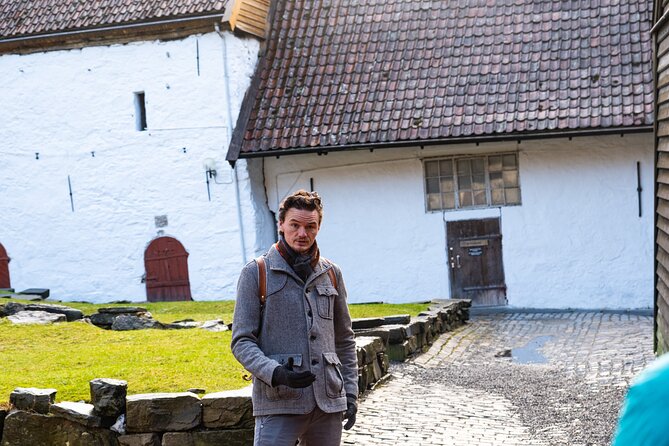
The next historical point is St. Mary’s Church, built in the 12th century and still used as a church. It is the oldest surviving building in Bergen, giving the tour another strong link to the medieval city.
The church is not included as an interior visit, since it has a separate admission fee. Your guide discusses its age and role from outside, then keeps the group moving toward the residential part of town.
This stop works well as a bridge between Bergen’s grand public history and the more ordinary neighborhoods that follow. You have seen the fortress, the royal hall, and the trading wharf. Now you begin to see how the older city connects to places where people lived and worked.
A different way to spend a day from here:
- From Bergen: The Original Fjord Cruise to Mostraumen
★ 4.7 · 8,440 reviews - Bergen: Mostraumen Fjord & Waterfall Cruise
★ 4.6 · 2,990 reviews - Bergen: City Tour on Foot
★ 4.9 · 1,327 reviews - Bergen: Viking Village, Nærøyfjord Cruise & Flåm Railway
★ 4.8 · 1,047 reviews
Climbing into Fjellsiden
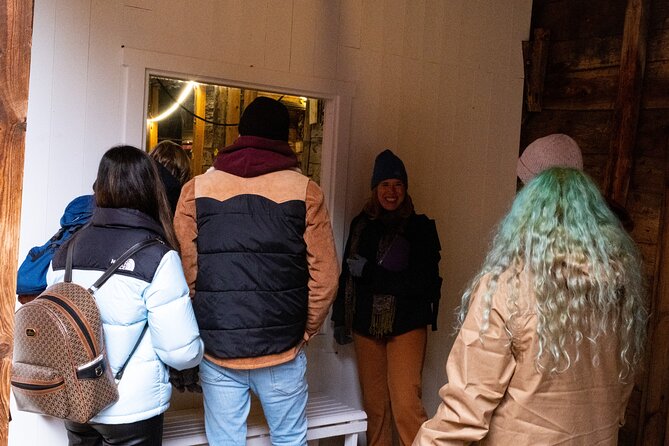
After the main history section, the route heads uphill into Fjellsiden. This district is known for its preserved wooden houses and quieter lanes. The change in mood is part of the point. You leave the main tourist corridor and see a side of Bergen shaped more by domestic life than by royal power or international trade.
The guide’s route here varies. That flexibility is useful because the walk is built around local interests rather than a fixed list of identical corners. One guide might focus on architecture, another on daily routines, food, or the way the neighborhood has changed.
This is also where the tour becomes most practical. You can hear about what Norwegians eat, when people work, what houses cost, and how taxes affect daily life. Those details help you understand the city beyond its postcard views. They also give you topics to ask about, especially if you want to compare life in Bergen with life at home.
The uphill section is not a technical hike, but you should have moderate physical fitness. The tour is a walking experience, not a flat harbor stroll. If you have limited mobility, ask before booking because the route includes both uneven surfaces and a climb.
The funicular station and Norway’s hiking culture
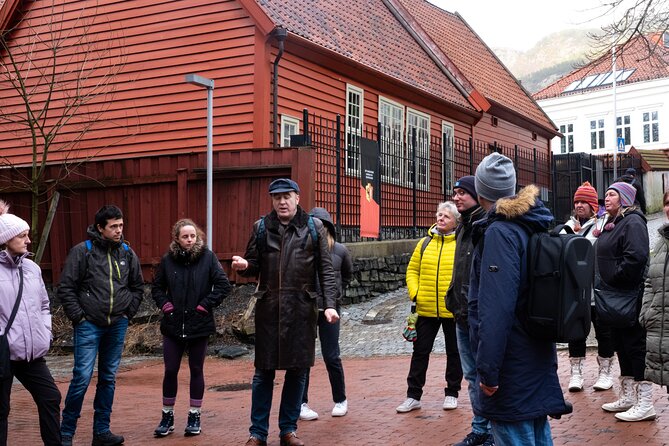
The walk passes the funicular station, but the group does not ride it. Taking the funicular would add about an hour and 150 NOK to the trip, and the tour leaves that choice to you.
That is a sensible decision. You may want to ride later for sunset, for the views, or to begin a hike at your own pace. Folding the funicular into this two-hour route would make the experience longer and less focused.
Instead, the guide talks about outdoor life and the importance of hiking in Norwegian culture. This is a small but valuable part of the walk because it explains why Bergen’s hills are not just scenery. They are part of how people use the city and spend free time.
If you plan to take the funicular after the tour, finishing the walking route first may help you decide how much time you want at the top. The guide can also point out where the station is, so you do not have to search for it later.
Skostredet and Bergen’s food culture
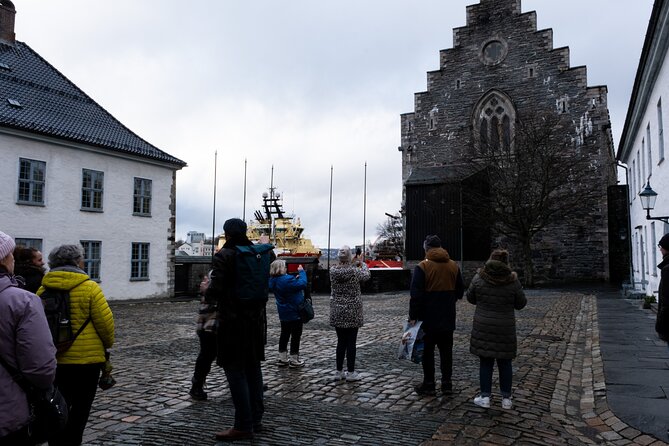
The final part turns toward modern Bergen, with about 20 minutes focused on food culture. The route passes along Skostredet, a popular restaurant street in the old town center.
Bergen is a UNESCO City of Gastronomy, and the guide connects that title to the city’s present-day eating scene. The discussion is not limited to historic fish trading. It includes local food habits and suggestions for places to eat, with several guides offering restaurant and coffee recommendations based on what you enjoy.
That advice can be especially useful early in your visit. A short conversation about what you like to eat may lead to better choices than simply selecting the busiest place near the harbor. Guides such as Emma, Anaïs, Jeff, and Dane are repeatedly praised for offering food and coffee tips along with the history.
The route ends at the Fish Market and tourist office at Vågsallmenningen 2. This is a convenient finish because you are close to public transportation, central sights, and the tourist office. You can continue exploring, ask for directions, or use the location as a base for your next activity.
What the guide adds
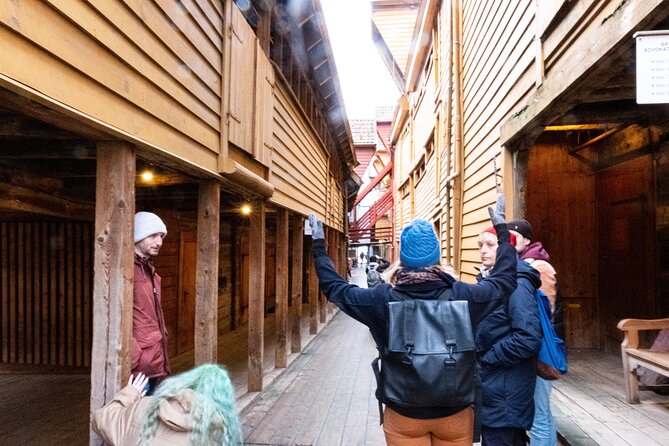
The tour’s value depends heavily on the person leading it. The listed guides include Jeff, Janine, Dane, Emma, Magda, Anaïs, Erik, Neil, and Eriik, and the strongest descriptions of the experience focus on clear storytelling, local advice, and a willingness to answer questions.
Jeff is noted for explaining history in plain English and discussing the advantages and drawbacks of living in Bergen. Dane is praised for connecting historical events to their wider effects, as well as presenting Norwegian history, language, and culture with humor. Janine is described as attentive and charming, while Emma is credited with balancing historical facts with present-day information.
That range matters. You are not booking a recorded script delivered at each stop. The route can shift based on the guide’s interests, and the conversation may become more useful if you ask about food, local customs, hiking, or places to visit next.
The tour is offered in English. Guide quality can vary from person to person, as it does on any guide-led walk, but the format gives each guide room to make the experience personal.
Price, timing, and practical value
At $33.47 per person, the tour is priced as an affordable introduction to Bergen rather than a full attraction package. You pay for a two-hour guided walk, an authorized guide, and outdoor access to Bergenhus Fortress and Bryggen. There are no hidden fees for the walking tour itself.
The price is good value if you are new to Bergen and want context before spending money on museums, food, or the funicular. You can use the walk to decide which paid sights deserve your time. It is less useful if you want interior access to historic buildings or a long, specialized lecture about one period.
The tour is often booked around 38 days in advance, which suggests you should reserve ahead if your schedule is fixed. Confirmation arrives at booking, and free cancellation is available up to 24 hours before the start time. Cancellations inside that window are not refunded.
The experience requires good weather and a minimum number of participants. If poor weather or low enrollment cancels it, you are offered another date or experience, or a full refund. Service animals are allowed, and the route is near public transportation.
Who should book this walk?
I would choose this tour for a first visit, especially if you have only a day or two in Bergen. It gives you the city’s basic framework quickly, then adds the kind of local information that helps you plan the rest of your stay.
It also suits cruise passengers who want an organized introduction and can comfortably walk for two hours. The start and finish are both central, and the ending near the Fish Market makes it easy to continue on foot.
Repeat visitors can still find value in the Fjellsiden section and the discussion of modern Norwegian life. If you already know Bryggen and the fortress well, the everyday details, restaurant ideas, and changing local route may be the main reason to go.
I would think twice if you need a fully accessible flat route, dislike outdoor tours in uncertain weather, or want to enter museums and churches. This walk is about seeing the city from the street and understanding how its pieces fit together.
Should you book Walking Tour in Bergen of the Past and Present?
Book it if you want a friendly Bergen orientation with both old and new in the same route. The best features are the small group size, the local guides, the practical talk about Norwegian life, and the way the walk moves beyond the main Bryggen photo stop.
Do not book it as a substitute for Håkon’s Hall, St. Mary’s Church, or a funicular ride. Those require separate time and, in some cases, separate fees. Think of this tour as your city primer: two hours to understand the fortress, wharf, hills, food culture, and local rhythm before you explore on your own.
FAQ
Where does the walking tour begin?
It begins at Bradbenken 1, 5003 Bergen, Norway, by Bergenhus Fortress.
Where does the tour finish?
The tour ends at Vågsallmenningen 2, 5014 Bergen, outside the Fish Market and near the Bergen tourist office.
How long does the tour last?
The tour lasts approximately two hours.
Is the tour offered in English?
Yes. The tour is offered in English.
Does the tour enter Håkon’s Hall?
No. Håkon’s Hall is a paid museum, and the tour discusses it from outside.
Does the tour enter St. Mary’s Church or the Bryggen buildings?
No. The tour is outdoors only. St. Mary’s Church has a separate admission fee, and the Bryggen buildings are shops and small businesses rather than included museum visits.
Does the tour ride the funicular?
No. The guide points out the funicular station and discusses hiking culture, but the group does not ride. Taking the funicular would add about one hour and 150 NOK.
How large is the tour group?
The maximum group size is 16 people.
Can I cancel for a refund?
You can cancel at least 24 hours before the start time for a full refund. Changes or cancellations made less than 24 hours before the start time are not accepted or refunded. If the tour is canceled because of weather or insufficient enrollment, you are offered another date or experience, or a full refund.
Recently added around Bergen
- Arrival Private Transfer from Bergen Airport BGO to Bergen by luxury minivan★ 5.0 · 3 reviews
- Private Day Tour- Flam Railway & Fjord Cruise From Bergen★ 5.0 · 3 reviews
- Trolltunga Helicopter & Waterfalss Sightseeing From Bergen★ 5.0 · 3 reviews
- Three-summit hike in Bergen★ 5.0 · 3 reviews
- From Bergen: Modalen Private Fjord Cruise with Waterfalls★ 5.0 · 3 reviews
- PRIVATE GUIDED TOUR: Norway’s Highlights – Viking Special, 11-12 hours – WINTER★ 5.0 · 3 reviews
- Fangene på Fortet Bergen: Prison Island Adventure Escapegame★ 5.0 · 3 reviews
- Bergen to Hardangerfjord VIP car + private yacht Fjord cruise★ 5.0 · 3 reviews
Bergen Tours, compared.
Past & Present Small Group Guided Walking Tour
Read our review →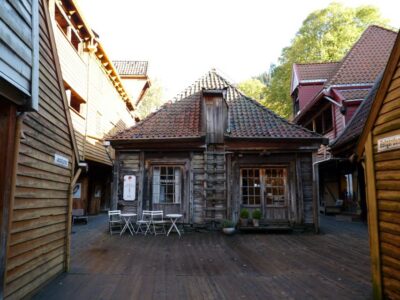
Viking Village, Nærøyfjord Cruise & Flåm Railway
Read our review →
Guided Tour To Nærøyfjorden, Flåm And Stegastein – Viewpoint Cruise
Read our review →

Browse the lists this tour appears in